UK prioritised ties with UAE over averting mass atrocities in Sudan, MPs to be told

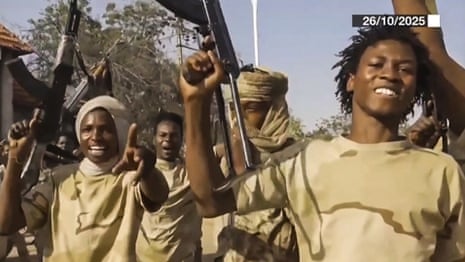
A group of men wearing khaki camouflage T-shirts celebrate raising assault rifles in the air.
theguardian.org

The British government had received intelligence that Ethiopia appeared to be supporting a genocidal militia in Sudan’s civil war as far back as 2024 but did not go public with the news for fear of upsetting the United Arab Emirates (UAE), a parliamentary committee will hear.

In May 2024, officials from the Foreign, Commonwealth and Development Office (FCDO) told Nathaniel Raymond, an American human rights investigator at Yale University, that “significant private pressure” from the UAE meant the UK would not publicly divulge information linking Ethiopia and the emirates to their support for the paramilitary Rapid Support Forces.

Ethiopia’s role in Sudan’s civil war did not become public until early this year. It continues to deny involvement.

In testimony to a parliamentary select committee on Tuesday, Raymond will allege that the UK government was more interested in preserving relations with the Emiratis than averting mass atrocities in Sudan.

The Commons international development committee is investigating the UK’s response to atrocity prevention after reports in the Guardian about the FCDO’s response to the RSF seizing the city of El Fasher, last year.

Raymond will also focus on what he describes as the UK’s “failed efforts to prevent the mass killing” of tens of thousands of people during the RSF’s genocidal massacre in El Fasher.

His testimony will include details of how a senior FCDO official attempted to downplay the huge death toll in El Fasher for “political” reasons.

After El Fasher fell to the RSF, following an 18-month siege, Raymond, director of Yale’s Humanitarian Research Lab (HRL), privately briefed the international development committee that at least 60,000 civilians had been killed.

An FCDO atrocity-prevention official contacted Raymond to ask if the figure was too high.

Raymond responded that his number did not include deaths from famine or the RSF’s bombardment of the city during its siege.

“I explained the math. I stated that, in reality, the number of people that the RSF systematically killed after capturing the city could have been higher,” said Raymond.

“The FCDO official and I discussed numbers further. I came to believe that this estimate of at least 60,000 people killed by the RSF was a political problem for the FCDO.”

Based on three years of encrypted messages, internal meeting notes, memos and phone records between the HRL and FCDO, Raymond’s testimony will also reveal how on 26 September 2025, a British UN official “expressed despair about the lack of any possible action by the Starmer government as the city was about to fall” – amid intelligence indicating that mass atrocities were inevitable.

Raymond’s revelations of longstanding Ethiopian involvement in Sudan’s war relate to 15 May 2024, when he met FCDO officials in London and shared collated data from mobile phones inside RSF headquarters during discussions on El Fasher’s worsening predicament.

HRL had tracked handsets moving between Ethiopia’s capital, Addis Ababa, to RSF-held territory in Sudan.

Some phones, Raymond will tell the committee, moved from RSF locations to addresses in the emirates, which HRL believes were shell companies linked to the RSF’s deputy commander, Abdul Rahim Dagalo.

One phone moved to Abu Dhabi from Addis Ababa in four hours, despite no official air traffic data or scheduled commercial flights matching the route, indicating deliberate attempts to evade detection.

FCDO officials requested Raymond to publicly release the phone data analysis linking UAE-based facilities to the RSF because the UK government could not.

Raymond will tell the committee: “They told me that the UK was facing significant private pressure behind the scenes from the UAE, limiting its ability to affect the situation.

“FCDO personnel suggested that HRL releasing this information could help neutralise these efforts by UAE to prevent the UK from linking them to the armament of the RSF.”

At the time, HRL could not share the telecommunications data publicly because it would compromise sources and operational methods.

However, HRL secretly shared the data with the US to support sanctions against Dagalo-linked shell companies.

Details of Ethiopia’s involvement in the Sudanese conflict became public in February after Reuters reported that Addis Ababa was hosting a camp to train RSF fighters.

Reuters said the move was backed by Ethiopia’s close ally, the UAE.

Ethiopia rebutted the reports, as did the UAE, which has also denied repeated accusations that it funds and arms the RSF.

Raymond will tell the MPs that he believes the FCDO prioritised the UK government’s “economic, security and diplomatic relationships with the UAE above preventing the intentional starvation and genocidal slaughter of tens of thousands of civilians living in El Fasher”.

He will add the UK’s position as “penholder”, or lead country, on Sudan at the UN security council meant its role was vital.

“The UK was our best hope at that time for stopping what we believed would become one of the single largest mass-casualty events of the 21st century.”

The FCDO was contacted for comment.
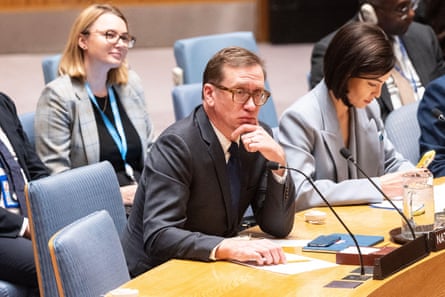
Nathaniel Raymond sitting at a conference bench with other delegates.
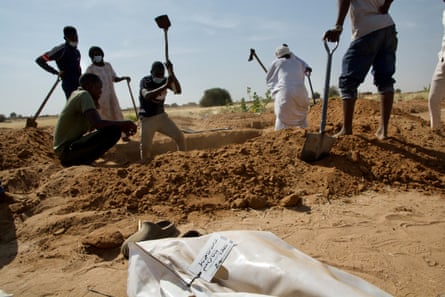
People dig in ground along a dirt road.
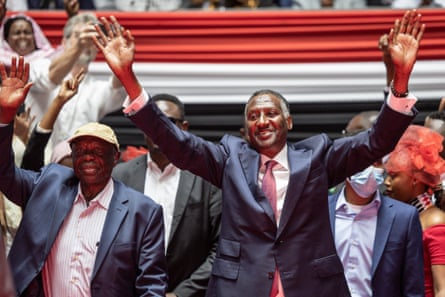
Abdul Rahim Dagalo, wearing a suit and tie, walks at the head of a crowd with his hands raised in greeting.
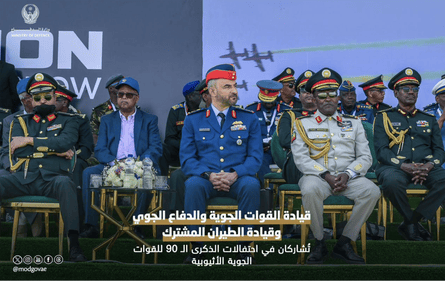
Arab and African military officers sitting on a podium

Continue ReadingUK prioritised ties with UAE over averting mass atrocities in Sudan, MPs to be told

Sweat, tears and camaraderie as 20,000 runners take on world’s largest ultramarathon

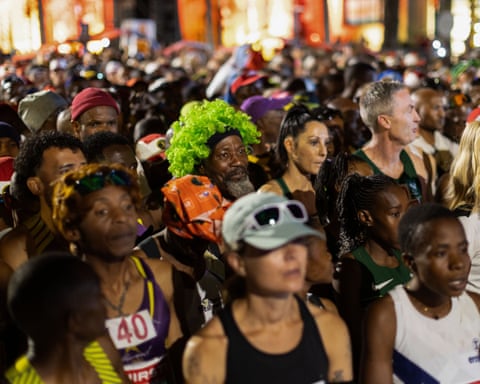
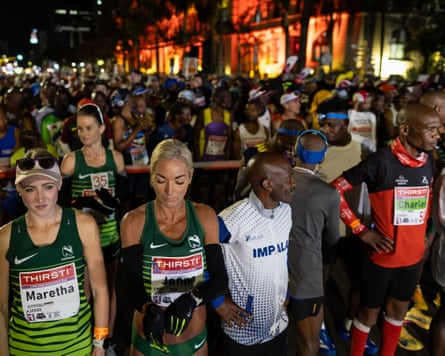
A dense crowd of runners wearing race numbers and costumes gather at night under bright city lights

In the early morning dark, thousands of runners waited, jostling with anticipation. South Africa’s national anthem rang out. Then the haunting swell of Shosholoza, first sung by Zimbabwean migrant workers in South Africa’s goldmines. Finally, that unmistakable, spine-tingling piano: Chariots of Fire.

5am. A cock crowed. A gun fired. The runners streamed across the start line of the Comrades marathon.

The Comrades is the world’s oldest and largest ultramarathon. The first race in 1921 took the runners 54.6 miles (88km) from Pietermaritzburg downhill to Durban on the coast. The following year the race was run in reverse, uphill back to Pietermaritzburg, and it has changed direction every year since, pausing only for the second world war and the Covid-19 pandemic. Over its 99 iterations, the route distance has averaged just under 55 miles.

That first year, 34 runners, all white men, lined up for the race, conceived by the first world war veteran Vic Clapham as a way of honouring his fallen comrades. Sixteen of them finished. More than a century later, on 14 June, more than 20,000 people stood outside Durban city hall, hoping to make it to Pietermaritzburg before the 12-hour cutoff.

What started as an all-white, all-male test of physical endurance has become part of the fabric of South African life, something so ordinary that you would be hard-pressed to find someone here who does not know a Comrades finisher.

Running clubs bus in from all over the country. Security guards and shop workers line up alongside bankers and celebrities. And, for one day, every June, South Africa’s searing racial inequality seems to melt away.

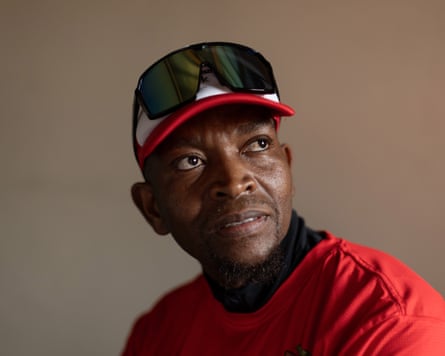
You hear it all around the race: every runner has their reason. William Seleka started running in March 2025, amid a deep depression after the break-up of his marriage. “I thought for me to stay alive, I had to keep myself busy,” he said, as he stretched before a run, outside the single room he rents in the Johannesburg township of Alexandra, two weeks before Comrades.

Seleka was persuaded to join Run Alex, a local club. Six months later, having never run further than 10km, he finished a 50km ultramarathon, from Johannesburg to Pretoria.

“I used to hear people saying, ‘This is Comrades, you are running from Durban to Pietermaritzburg.’ I said, ‘It’s insane, you can’t do that.’ But now we are facing reality – I’m doing that as well,” he said.

To train, Seleka ran at least 10km every weekday evening, after a day spent repairing appliances for fridge-maker Smeg. On Saturdays, the 38-year-old would run up to 50km with Run Alex. “Recovery,” he said, was a half marathon.

Seleka said he wanted to create a legacy for his 15-year-old son and three-year-old daughter. “I can’t wait to have my red cap and the medal to show my kids.”

On a Comrades “up run”, runners must climb about 1,800 metres (5,900ft) on their journey to Pietermaritzburg, 650 metres higher than Durban. This year, runners started in three batches, at 5am, 5.15am and 5.30am.

About 12 miles into the race, the sun began peeking above the horizon in Pinetown, a suburb above Durban. “Let’s go! Let’s go!” spectators shouted. Seleka appeared up the hill. “Good to see you,” he beamed, sweeping in for a glancing hug.

In 1923, Frances Hayward became the first woman to start and finish the Comrades. In 1935, Robert Mtshali was the first black man to complete the race. Nonetheless, with only white men officially allowed to compete, the Comrades seemed fated to stay what most ultramarathons remain today – a niche, elite pursuit.

That changed in 1975 when the privately run race was desegregated and also opened to women. South Africa at the time had been shut out of all major global sporting events in response to apartheid, driving the sport-obsessed country mad.

“Some people in the sporting world in South Africa had the idea that if they start desegregating some minor sports … it’ll show that South Africa is not as backward and racist a place as it’s made out to be,” said Ryan Lenora Brown, a journalist who has been covering the Comrades since 2017.

Then there was the introduction of TV in 1976. The single, heavily censored state channel started showing Comrades highlights. In 1986, it broadcast the entire, all-day race in full.

South Africans were mesmerised by the sight of delivery driver Hoseah Tjale going toe to toe with Bruce Fordyce, a professional athlete who won eight Comrades in a row from 1981.

“You would have these scenes in the 1980s of a white runner sharing a bottle of water with a black runner, which was such a small gesture, but such a huge thing in that society that was so divided,” said Brown.

Apartheid had forced black South Africans on to the lowest rungs of society. But Tjale and Sam Tshabalala, the first black man to win Comrades in 1989, were proof that they could do anything.

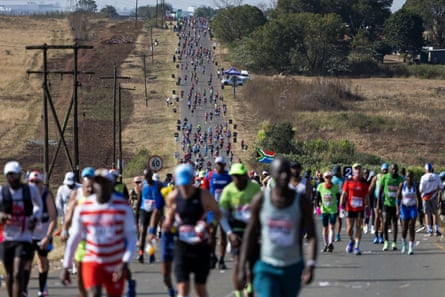
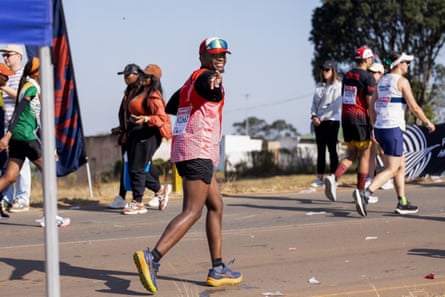
As the runners left Durban, they wound their way upwards through lush trees, open fields and small towns. Families braaied by the roadside. Running clubs handed out supplies from gazebos pumping out music. Everybody was cheering the runners, willing them on.

By the halfway point, most were walking up each hill. At the Run Alex aid station, Seleka changed into a spare pair of shoes. It was the wrong choice: by 34 miles he was in agony. The only way he could distract himself from the pain was by counting or singing.

“I’m not a person who goes to church,” he said. “But on that day I started to sing. I don’t know where those songs came from.”

Around 46 miles, Seleka found another Run Alex aid station and put on a clubmate’s shoes. He pushed on.

The light turned golden. Some runners danced across the finish line, arms outstretched. Some were arm in arm, complete strangers who had become friends on the road. Many stumbled over the line, or collapsed and were carried away on waiting stretchers.

Darkness began to fall. Guns were fired for the first 12-hour cutoff, and then the second. Around a third of Comrades runners finish in the final hour.

South Africa’s pacing “buses” are unique in long-distance running for their size and camaraderie, racers singing and chanting, led by a metronomic pacer, known as a bus driver. Perhaps the biggest cheer of the day came when the final 12-hour bus driver, Shahieda Thungo, crossed the line at 11:56:34, carrying dozens of runners home with her. About 91% of runners finished this year, according to The Running Mann blog.

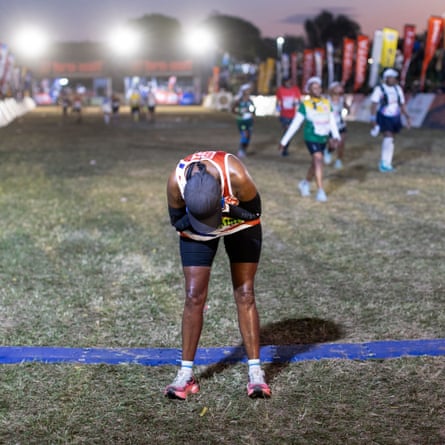
Then there were those who just missed the cutoff. At exactly 5.30pm, a wall of people stepped across the finish line. Two women ran into them, seconds short. One, wearing the green bib of a 10-time finisher, doubled over in anguish, her face in her hands.

Seleka cried as he crossed the line at 10:30:49. He was thinking of his sister, whose kidneys failed in 2018. “At the start, everything changed,” he said. “I said this pain today is for my younger sister.”

Everyone needs a reason if they are to finish the Comrades, said Seleka, who was already planning his race next year. “If you’re going through a lot, once you say why, then it’s a mission,” he said. “After Comrades is accomplished, it’s a new chapter again.”

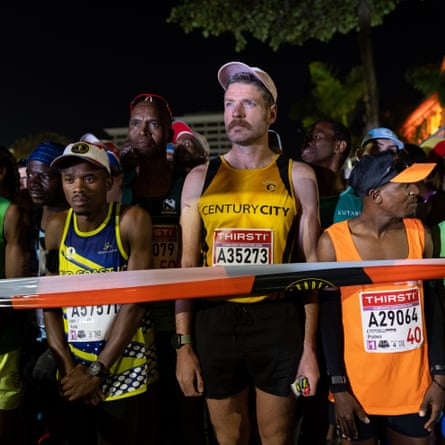
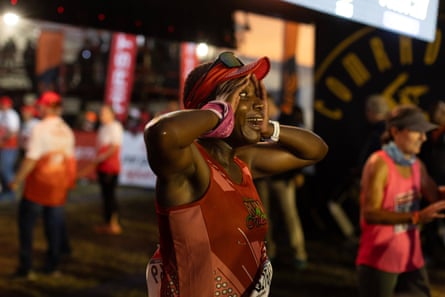
Athletes gather in the dark before the start of the Comrades Marathon in Durban
Runners depart from Pietermaritzburg
Athletes gather in the dark before the start of the Comrades Marathon in Durban
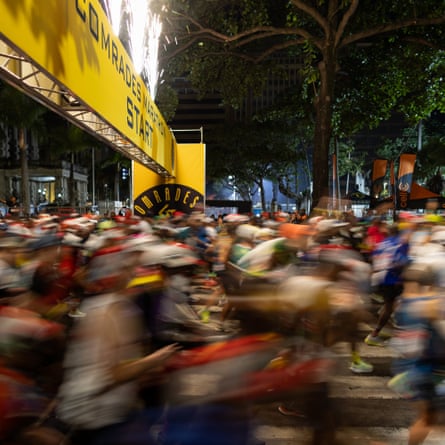
Blurred runners in the street
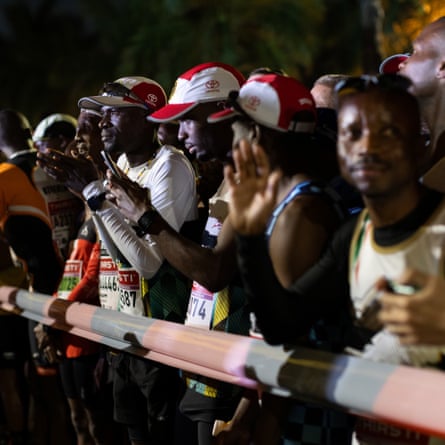
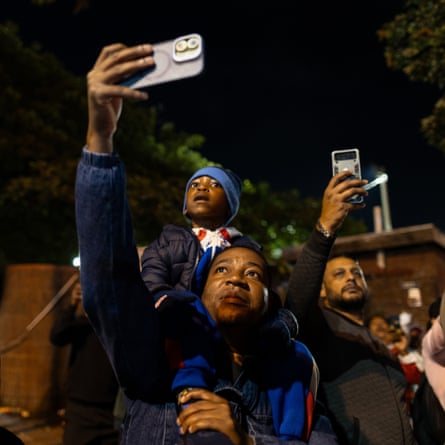
Supporters hold up mobile phones
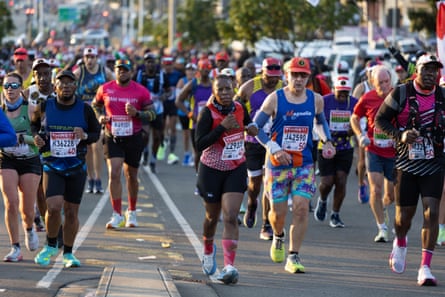
Runners fill the street
Runners take part in Comrades ultramarathon
William Seleka poses for a portrait photograph
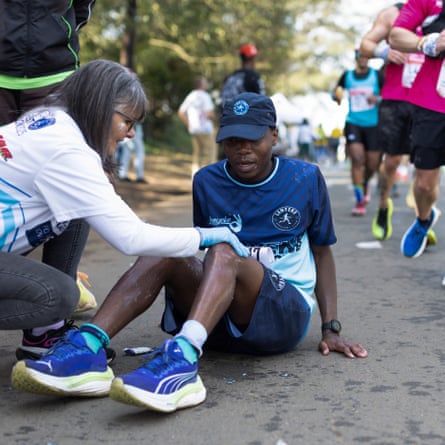
A runner receives a leg-rub from a volunteer along the route
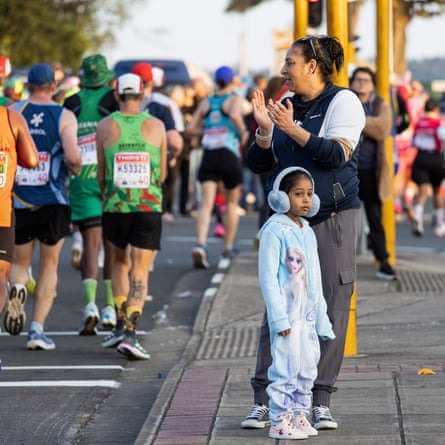
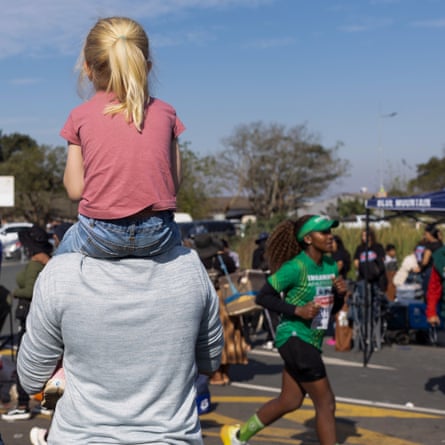
Spectators cheer on the runners
Runners all along a road
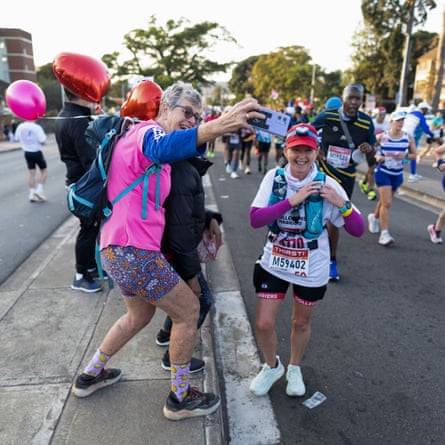
Supporters take photos with a runner in Pinetown
Spectators lined the route out of Camperdown
William Seleka near Camperdown
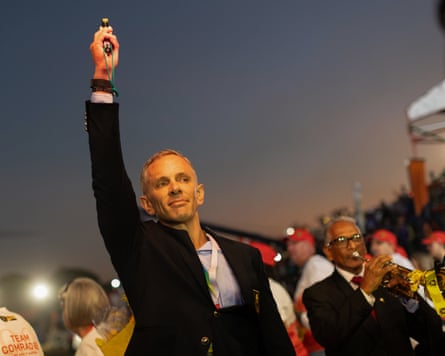
An official prepares to fire the shot to mark the final 12-hour cutoff time.
Jenny Da Silva stands bent over with her head in her hands
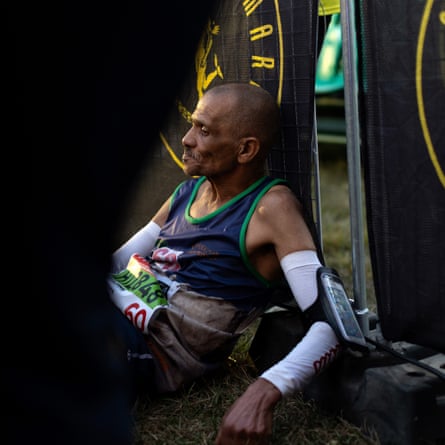
An exhausted runner rests shortly after crossing the finish line
Comrades ultramarathon finish line
A member of the Run Alex team crosses the finish line in Pietermaritzburg.

Continue ReadingSweat, tears and camaraderie as 20,000 runners take on world’s largest ultramarathon

Global framework for reparatory justice adopted at landmark Ghana conference

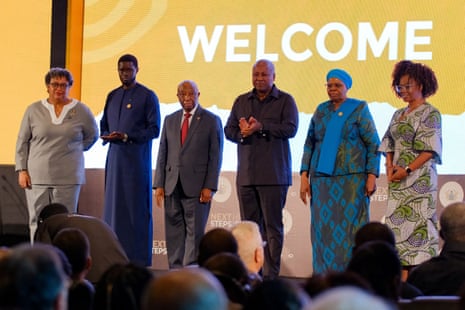
John Dramani Mahama joined on stage by Mia Mottley, Bassirou Diomaye Faye, Joseph Boakai Sr, Netumbo Nandi-Ndaitwah

A global framework for reparatory justice has been adopted at a conference in Ghana.

Heads of state, governments and other officials adopted the strategy on Friday at a gathering in a hotel in the capital, Accra, which was the first major meeting since the adoption of the landmark United Nations (UN) resolution declaring the trafficking of enslaved Africans as the gravest crime against humanity.

The document lays out an 18-point global framework for reparatory justice. They include resolving to ensure fair and adequate compensation for Africans and people of African descent, including those affected by legacies of enslavement, colonialism, genocide and apartheid, and resolving to accelerate the return of cultural property, human remains, archives and heritage to countries of origin.

The framework also calls for multilateral measures to address sovereign debt burdens, including debt relief, restructuring and cancellation to address enduring socioeconomic consequences of enslavement, colonialism and related historical injustices.

“We recognise and honour the extensive efforts undertaken over generations by several governments, intergovernmental organisations, our forebearers, individuals and civil society partners across Africa, the Caribbean, the Americas, as well as in Europe and Asia in shaping the global reparations agenda,” the participants say in the document.

“We adopt this document as a basis for global collaboration and commit to engaging in transparent, constructive and good faith dialogue in advancing reparations and reparatory justice among all state and non-state actors.”

Ruth Ogbewekon, the project lead on reparatory Justice at the Pan African Lawyers Union who supported the preparation of the document, said the process tried to be inclusive given the pressures to build on the momentum of the resolution towards a global movement for reparatory justice.

She added that representatives from Africa and the African diaspora, as well as non-African allies, were consulted over several weeks. “Ultimately, it was a process where people wanted to be heard and to see that they were heard, and the events in Accra provided that” she said.

The adoption came on the last day of a three-day conference billed Next Steps that also resulted in the establishment of three global panels on reparatory justice and restitution.

On Thursday, Ghana’s president, John Mahama, announced the creation of an advisory panel on reparatory justice, an expert panel on the restitution of cultural artefacts, and a legal panel on reparatory justice “to serve as the pillars of the next phase of this international effort”.

“These panels are not intended to replace the work of governments, regional organisations, or international institutions,” Mahama told hundreds of participants. “Rather, they are intended to strengthen that work by providing intellectual, technical and policy support as the international community advances from recognition to implementation.”

The advisory panel on reparatory justice is made up of leaders of countries with historic ties to the transatlantic slave trade in Africa, Latin America and the Caribbean. They include Mahama, prime minister Mia Mottley of Barbados and presidents Joseph Boakai Sr, Netumbo Nandi-Ndaitwah and Bassirou Diomaye Faye of Liberia, Namibia and Senegal.

The three-day event started on Wednesday and has attracted heads of state and government, ministers, civil society representatives, historians, researchers and legal experts from more than 80 countries.

The conference is happening nearly three months after the UN general assembly voted to adopt a proposal by Ghana on behalf of AU member states to recognise the trafficking of enslaved Africans and the racialised chattel enslavement of people from the continent as the gravest crime against humanity.

The resolution, a turning point for Africa’s quest for reparatory justice, calls for UN member states to have “inclusive, good-faith dialogue” on reparatory justice and “prompt and unhindered” restitution of properties that are of value to their countries of origin.

Thursday’s events also featured documentary screenings, a music performance, a stage play and remarks by heads of state and government, ministers, civil society representatives and leaders of international organisations. Many called for a united approach to the quest for reparatory justice.

In his keynote address, Mahama, who is also the African Union Champion on Reparations, said the adoption of the resolution was intended to provide the foundation for “more meaningful” engagement, reflection, and action on reparatory justice.

He urged a global partnership by a broader community of nations and institutions in the pursuit of reparatory justice, noting that Caribbean Community’s (Caricom’s) 10-point reparation plan would serve as “an important starting point for the work of the new panels.

“We’re here because recognition creates responsibility, and because the enduring consequences of this history continue to demand thoughtful, coordinated and sustained international engagement,” he said.

“The crime we seek to address was transcontinental in its reach. Its consequences remain transcontinental in its impact, and the search for justice must therefore be transcontinental in its ambition.”

Mottley announced a revision of Caricom’s 10-point reparation plan to factor in the disproportionate impact of slavery on girls and women. She also encouraged a coordinated global effort to pursue reparatory justice.

“Let us not embark on separate journeys, but let us today reflect the unity of purpose, the recognition that whether it is through advocacy or advisory opinions or actions, our role is to ensure that there is no retreat from our requests and that we recognise that repair comes after recognition,” she said. “For in all that we do in the rest of our lives, where damage is perpetrated, repair is always, always required.

Boakai Sr said the UN resolution “opened a door” and collective resolve would determine whether it would lead to “meaningful justice, reconciliation and healing”.

“Let us not be remembered as another conference or another resolution that stirs consciences briefly before fading into history,” he said.

“Let us … leave Accra united in purpose and committed to ensuring that the greatest crime against humanity is met with one of humanity’s greatest responses: a determined global effort to restore dignity, repair historical wrongs and build a future founded on equality, shared prosperity, and our common humanity.”

Thursday’s events were preceded on Wednesday by consultations led by technical experts to formulate the framework.

Later on Friday, at Osu Castle, a 17th-century fortress in the capital built by the Danish that served as a hub for the transatlantic slave trade, attendees will take part in an event to honour Juneteenth, which marks the end of slavery in the US.

The Guardian’s connections to enslavement: can an institution atone for its history?

On Thursday 2 July, join Maya Wolfe-Robinson, Ebony Riddell Bamber, Prof Verene A Shepherd and Ahmad Ward in this free event for a wide-ranging discussion on the Guardian’s Legacies of Enslavement programme. Book tickets here or at guardian.live

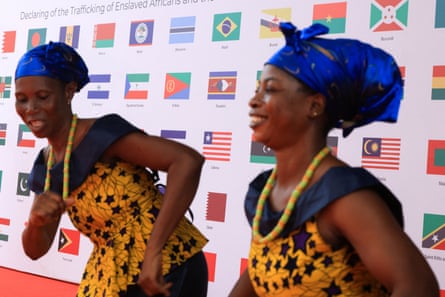
Dancers perform in front of a backdrop displaying country flags.
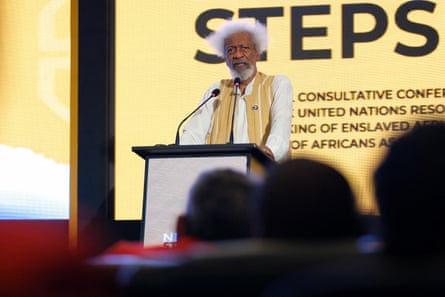
Wole Soyinka gives a speech during the conference in Accra.

Continue ReadingGlobal framework for reparatory justice adopted at landmark Ghana conference

Global framework for reparatory justice adopted at landmark conference in Ghana

John Dramani Mahama joined on stage by Mia Mottley, Bassirou Diomaye Faye, Joseph Boakai Sr, Netumbo Nandi-Ndaitwah

A global framework for reparatory justice has been adopted at a conference in Ghana.

Heads of state, governments and other officials adopted the strategy on Friday at a gathering in a hotel in the capital, Accra, which was the first major meeting since the adoption of the landmark United Nations (UN) resolution declaring the trafficking of enslaved Africans as the gravest crime against humanity.

The document lays out an 18-point global framework for reparatory justice. They include resolving to ensure fair and adequate compensation for Africans and people of African descent, including those affected by legacies of enslavement, colonialism, genocide and apartheid, and resolving to accelerate the return of cultural property, human remains, archives and heritage to countries of origin.

The framework also calls for multilateral measures to address sovereign debt burdens, including debt relief, restructuring and cancellation to address enduring socioeconomic consequences of enslavement, colonialism and related historical injustices.

“We recognise and honour the extensive efforts undertaken over generations by several governments, intergovernmental organisations, our forebearers, individuals and civil society partners across Africa, the Caribbean, the Americas, as well as in Europe and Asia in shaping the global reparations agenda,” the participants say in the document.

“We adopt this document as a basis for global collaboration and commit to engaging in transparent, constructive and good faith dialogue in advancing reparations and reparatory justice among all state and non-state actors.”

Ruth Ogbewekon, the project lead on reparatory Justice at the Pan African Lawyers Union who supported the preparation of the document, said the process tried to be inclusive given the pressures to build on the momentum of the resolution towards a global movement for reparatory justice.

She added that representatives from Africa and the African diaspora, as well as non-African allies, were consulted over several weeks. “Ultimately, it was a process where people wanted to be heard and to see that they were heard, and the events in Accra provided that” she said.

The adoption came on the last day of a three-day conference billed Next Steps that also resulted in the establishment of three global panels on reparatory justice and restitution.

On Thursday, Ghana’s president, John Mahama, announced the creation of an advisory panel on reparatory justice, an expert panel on the restitution of cultural artefacts, and a legal panel on reparatory justice “to serve as the pillars of the next phase of this international effort”.

“These panels are not intended to replace the work of governments, regional organisations, or international institutions,” Mahama told hundreds of participants. “Rather, they are intended to strengthen that work by providing intellectual, technical and policy support as the international community advances from recognition to implementation.”

The advisory panel on reparatory justice is made up of leaders of countries with historic ties to the transatlantic slave trade in Africa, Latin America and the Caribbean. They include Mahama, prime minister Mia Mottley of Barbados and presidents Joseph Boakai Sr, Netumbo Nandi-Ndaitwah and Bassirou Diomaye Faye of Liberia, Namibia and Senegal.

The three-day event started on Wednesday and has attracted heads of state and government, ministers, civil society representatives, historians, researchers and legal experts from more than 80 countries.

The conference is happening nearly three months after the UN general assembly voted to adopt a proposal by Ghana on behalf of AU member states to recognise the trafficking of enslaved Africans and the racialised chattel enslavement of people from the continent as the gravest crime against humanity.

The resolution, a turning point for Africa’s quest for reparatory justice, calls for UN member states to have “inclusive, good-faith dialogue” on reparatory justice and “prompt and unhindered” restitution of properties that are of value to their countries of origin.

Thursday’s events also featured documentary screenings, a music performance, a stage play and remarks by heads of state and government, ministers, civil society representatives and leaders of international organisations. Many called for a united approach to the quest for reparatory justice.

In his keynote address, Mahama, who is also the African Union Champion on Reparations, said the adoption of the resolution was intended to provide the foundation for “more meaningful” engagement, reflection, and action on reparatory justice.

He urged a global partnership by a broader community of nations and institutions in the pursuit of reparatory justice, noting that Caribbean Community’s (Caricom’s) 10-point reparation plan would serve as “an important starting point for the work of the new panels.

“We’re here because recognition creates responsibility, and because the enduring consequences of this history continue to demand thoughtful, coordinated and sustained international engagement,” he said.

“The crime we seek to address was transcontinental in its reach. Its consequences remain transcontinental in its impact, and the search for justice must therefore be transcontinental in its ambition.”

Mottley announced a revision of Caricom’s 10-point reparation plan to factor in the disproportionate impact of slavery on girls and women. She also encouraged a coordinated global effort to pursue reparatory justice.

“Let us not embark on separate journeys, but let us today reflect the unity of purpose, the recognition that whether it is through advocacy or advisory opinions or actions, our role is to ensure that there is no retreat from our requests and that we recognise that repair comes after recognition,” she said. “For in all that we do in the rest of our lives, where damage is perpetrated, repair is always, always required.

Boakai Sr said the UN resolution “opened a door” and collective resolve would determine whether it would lead to “meaningful justice, reconciliation and healing”.

“Let us not be remembered as another conference or another resolution that stirs consciences briefly before fading into history,” he said.

“Let us … leave Accra united in purpose and committed to ensuring that the greatest crime against humanity is met with one of humanity’s greatest responses: a determined global effort to restore dignity, repair historical wrongs and build a future founded on equality, shared prosperity, and our common humanity.”

Thursday’s events were preceded on Wednesday by consultations led by technical experts to formulate the framework.

Later on Friday, at Osu Castle, a 17th-century fortress in the capital built by the Danish that served as a hub for the transatlantic slave trade, attendees will take part in an event to honour Juneteenth, which marks the end of slavery in the US.

The Guardian’s connections to enslavement: can an institution atone for its history?

On Thursday 2 July, join Maya Wolfe-Robinson, Ebony Riddell Bamber, Prof Verene A Shepherd and Ahmad Ward in this free event for a wide-ranging discussion on the Guardian’s Legacies of Enslavement programme. Book tickets here or at guardian.live

Dancers perform in front of a backdrop displaying country flags.
Wole Soyinka gives a speech during the conference in Accra.

Continue ReadingGlobal framework for reparatory justice adopted at landmark conference in Ghana

CDC to tap $107m in emergency funding for Ebola response in DRC and Uganda

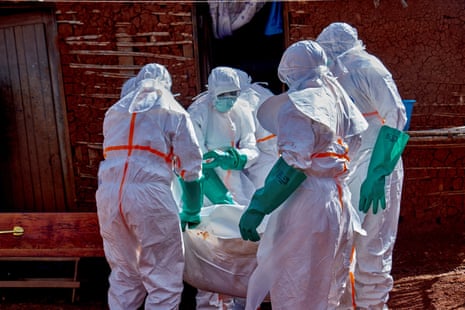
People in hazmat suits retrieve a body

The Centers for Disease Control and Prevention (CDC) will tap $107m in emergency funding for Ebola outbreak response in the Democratic Republic of the Congo (DRC) and Uganda, officials said on Thursday.

The continued Ebola outbreak in the DRC comes as Canada, Mexico and the US jointly host the Fifa World Cup, attracting visitors from around the world. The officials said the outbreak, now the third largest on record, required “strong immediate support”, but that the global risk remained low.

“Specifically, and consistent with that modeling, we are now already approaching 1,000 confirmed cases across 31 health zones in DRC,” Dr Satish K Pillai, incident manager for the CDC’s Ebola response, said in a briefing with reporters on Thursday, “There are 31 cases in Kampala, Uganda.”

Pillai said the CDC had 23 field staff supporting disease investigations and 125 staff members across the DRC and Uganda, and that CDC staff hold twice-weekly calls with the US World Cup host cities. To date, officials said local health authorities had mostly faced illnesses typical of large, Super Bowl-style events, such as heat-related illnesses.

An outbreak of Bundibugyo viral disease (BVD) began roughly one month ago along the western border of the DRC and the eastern border of Uganda. BVD is a rare zoonotic species of Ebola, a hemorrhagic fever. The disease killed between 30% and 50% of those infected in recent outbreaks in Congo and Uganda.

African health officials warn the outbreak could become the worst on record and take a year to contain at current infection rates. The worst Ebola outbreak on record infected more than 28,000 people and killed 11,000 between 2014 and 2016 in west Africa and the eastern DRC. The CDC reported 837 confirmed cases in the DRC and 19 confirmed cases in Uganda as of 15 June. Across both countries, 198 people have died.

Although the risk within the DRC and Uganda is high, global risk is low. The disease is transmitted from person to person through direct contact with blood, bodily secretions and contaminated surfaces. This is in contrast to airborne diseases, such as Covid-19 and measles, which are considered far more contagious.

Despite low global risk, the US is one of 22 counties that imposed travel restrictions on people coming from these countries, which have been criticized as impeding the response to the outbreak. Efforts to contain the disease have been hampered by mistrust and shortages of personal protective equipment and vehicles to transport dead bodies.

Emergency funding from the CDC would add to the roughly $910m already pledged to combat the Ebola outbreak, less than 10% of which has been received from donors, according to African health leaders.

“CDC activities are focused on controlling the outbreak in the Democratic Republic of Congo, controlling the outbreak in Uganda and ensuring our domestic readiness to respond in the unlikely event of cases,” said Pillai.

Continue ReadingCDC to tap $107m in emergency funding for Ebola response in DRC and Uganda

Barbados prime minister announces manifesto for slavery reparations

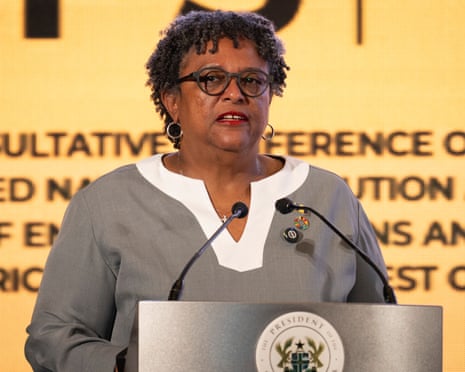
Mia Mottley, the prime minister of Barbados

Barbados’s prime minister, Mia Mottley, has announced a new manifesto from Caribbean leaders asserting the “moral, ethical and legal case” for reparations over damage caused by hundreds of years of enslavement.

Mottley was speaking at a “historic” conference in Ghana to advance the push for reparatory justice after the United Nations adopted a landmark resolution declaring the trafficking of enslaved Africans as the gravest crime against humanity.

The manifesto, which she distributed at the conference, is an update of the Caribbean Community (Caricom) 10-point plan for reparations from former colonial powers. It introduces new issues including the disproportionate impact of slavery on girls and women.

The plan includes a new specific call for compensation for gender-based violence, referencing data that suggests “women represented approximately 30% of the estimated 20 million Africans forcefully transported across the Atlantic Ocean”. It also mentions estimates that at least 1.2 million enslaved women experienced sexual violence.

Highlighting the update, Mottley said that “the compensation for gender-based violence and assault on family” is “no different from the compensation that has been awarded to other nationalities such as the Japanese”.

The draft, which has been seen by the Guardian, asserts that climate justice and slavery reparations are “inextricably linked”, and stresses the need for a plan to support Indigenous people who were in the Caribbean when Europeans arrived and were the subject of genocides.

The document, which is still to be rubber-stamped by Caribbean governments, makes it clear that Caricom is demanding monetary compensation, in addition to other forms of repair such as a full and formal apology, from Britain and other European countries, and education and training.

“Caricom demands monetary compensation as reparations from enslaving nations, monarchies, churches, institutions, corporations and families, for loss of life and uncompensated labour, loss of liberty, personal injury, mental pain and anguish and gender-based violence, for the victims of Indigenous genocide, the transatlantic trafficking of enslaved Africans and chattel enslavement of Africans, which constitute grave crimes against humanity,” the document says.

But it does not specify an amount that Caribbean countries are demanding, describing the plan instead as a “a collective vision for an approach to the pursuit of reparatory justice”.

Describing the conference as a “historic moment”, Mottley said: “We live in a world today where people call out people for everything, for misogyny, for sexual assault, for all kinds of behaviour. But yet we have not found the moral courage to state unanimously across humanity that this grave crime against humanity that persisted for centuries ought to be declared so by all.

“That others choose to remain silent is a reflection of them, not of us. We have equally come to say that there should be no retreat on repair. The language used from this platform this morning is not one of aggression, is not one of violence but it is one of the necessities for healing for humanity.”

Since 2013, Caribbean governments have repeatedly called for recognition of the lasting legacy of colonialism and enslavement, and for reparative justice from former colonisers.

In March, the UK was one of several European countries that abstained from voting for the UN general assembly resolution that described chattel slavery as the gravest crime against humanity. The resolution was passed after an overwhelming majority of 123 nations voted in its favour, with only the US, Israel and Argentina voting against it.

Caricom’s 52-page document, which the Caribbean Reparations Commission previously said was revised to include emerging scientific and historical evidence, has more explicit legal arguments, framing reparations as a global human rights imperative.

It stresses that crimes against humanity “are not subject to a statute of limitations”, meaning no matter how much time has passed since the crime happened “legal proceedings for accountability and justice can still be initiated”.

It backs this up with a reference to international laws such as the convention on the non-applicability of statutory limitations to war crimes and crimes against humanity, adopted by the United Nations in 1968.

The second update since the original 10-point plan was produced in 2014, the manifesto uses strong language, highlighting the “failure of former colonial powers to apologise and make amends for their racist actions against Indigenous and African ancestors and their descendants”.


Continue ReadingBarbados prime minister announces manifesto for slavery reparations