Bandits in north-west Nigeria abduct villagers they invited to discuss peace talks

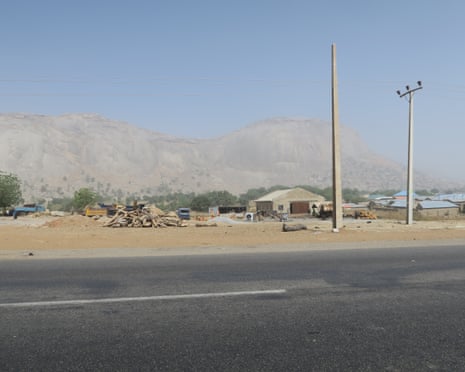
A paved road in the foreground, with barren hills, utility poles, scattered buildings, and stacked wood visible beyond

Armed bandits in north-west Nigeria abducted dozens of villagers whom they invited to a meeting about potential peace negotiations, authorities and residents said on Monday, highlighting the region’s worsening security.

According to local police, 39 people were seized on Sunday during a meeting in the forest near Magamin Diddi village in the Maradun municipality of north-west Zamfara state. But some residents and officials believe the number of those abducted could be as high as 50.

It is believed the victims were meeting the relatives of a bandit leader in the hope of bringing peace and easing restrictions imposed on the community.

“While the meeting was ongoing, the bandit kingpin allegedly arrived at the location with members of his gang and forcefully abducted 39 members of the group to an unknown destination,” a police spokesperson, Yazid Abubakar, said in a statement on Monday.

The chair of the Maradun local government told a local newspaper that authorities in the state were not in support of reconciliation with bandits.

According to the chair, the bandits had recently blocked all roads leading to the community market to show their anger over the persistent killing of their members by security operatives.

He questioned why the community chose to meet the aggrieved bandits, who were seeking an opportunity to retaliate.

Zamfara is at the centre of a long-running security crisis in which armed groups, locally referred to as bandits, carry out mass kidnappings, killings and village raids. The violence has disrupted farming and displaced thousands. Individual negotiations with kidnappers have occurred to gain access to farmland or secure the release of abductees despite authorities warning against it.

Security forces have deployed personnel and intelligence assets to locate the victims, the police statement said. Several individuals were reported by local people to have been released to convey the kidnappers’ ransom demands to the village.

Bashar Aliyu, a resident of Magamin Diddi, said the armed group was demanding 125m naira (£69,000) for the release of those abducted.

Abubakar said security operatives were working to rescue the captives and had assured residents that every effort was being made to ensure the victims were rescued unharmed and the perpetrators were brought to justice.


Continue ReadingBandits in north-west Nigeria abduct villagers they invited to discuss peace talks

‘Extreme fear’ among immigrants as backlash sweeps South Africa

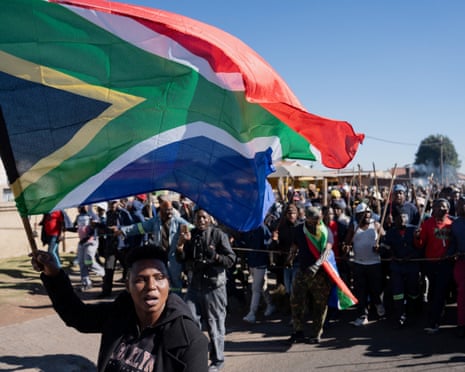
A person waves a large South African flag while walking in a street protest with a crowd behind them

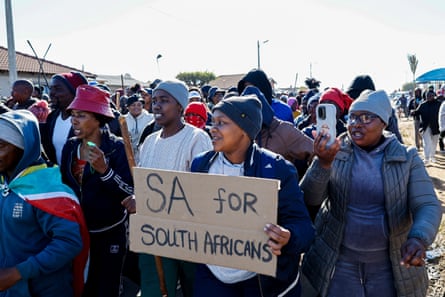
African migrants in South Africa say they are living in fear after a series of marches calling for illegal immigrants to leave reignited long-held xenophobic sentiment in the country.

March & March, a campaign group at the forefront of recent protests, has given people living illegally in the country until 30 June to leave, without specifying what will happen to those who do not.

Mozambique said five of its citizens were killed in “xenophobic attacks” at the end of May. South African police said two Mozambicans and one South African had died during an outbreak of violence in Mossel Bay on the south coast.

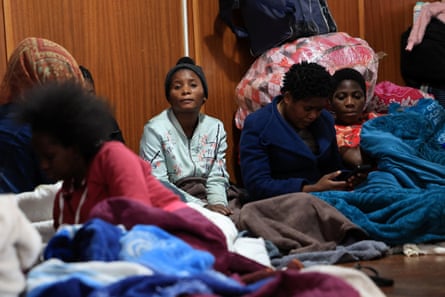
Roughly 60 miles south-east of Cape Town, about 100 people from Mozambique and Malawi sought shelter in Kleinmond town hall last week after an angry crowd told foreigners in an informal settlement they had to leave.

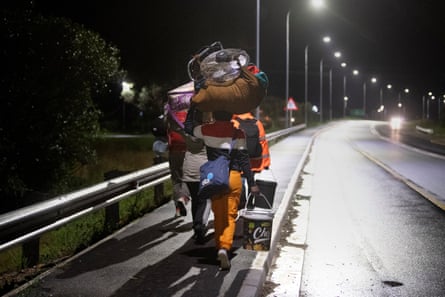
Many told Reuters news agency they wanted help from their governments to return home. Ghana has arranged flights for several hundreds of its citizens to leave South Africa.

“Every day and almost everyone I meet, they are in fear, extreme fear,” said an Ethiopian entrepreneur who moved to South Africa in 2000 and is married to a local woman. The couple have a 19-year-old daughter.

“The sad part is it’s not because they are undocumented … But none of the legal documents will protect you from the violence.”

South Africa has long imported migrant labour, particularly to work in its mines. After his election in 1994 ended white-minority rule, Nelson Mandela welcomed African migrants. Meanwhile, poverty and economic strife in many neighbouring countries, including hyperinflation in Zimbabwe, pushed people south.

Endemic unemployment and inequality led many South Africans to blame African immigrants for their problems, with resentment periodically erupting into violence. Sixty-two people were killed during riots in 2008, among them 21 South Africans, and more than 150,000 were displaced. In 2015, at least five people were killed.

The proportion of South Africans who said they would welcome all immigrants fell from a quarter in 2020 to 15% last year, according to surveys by the Human Sciences Research Council, a state body. The unemployment rate has risen by 3.4 percentage points to 43.1% since 2020.

Sharon Ekambaram, who leads the refugee and migrants’ programme at Lawyers for Human Rights, said: “People are struggling to hold the government to account and it’s easier to blame the migrants.”

South Africa’s foreign-born population almost trebled to 2.4 million between 1996 and 2022, according to census data, which aims to include undocumented people. That represented 3.9% of the 62 million population, up from 2% in 1996.

The March & March leader, Jacinta Ngobese-Zuma, who has campaigned for mass deportation, claims that illegal immigration “ranges from 15 million to about 30 million”.

“South Africa is currently being invaded. South Africans have become refugees in their own country,” she said last month.

Founded in March 2025, March & March has crisscrossed South Africa organising protests. On 30 March, the group led a demonstration in KuGompo City (formerly East London), after local people were angered by later-disproven reports that a Nigerian had been crowned king. Since then, marches have taken place in cities including Durban, Johannesburg and Pretoria.

Asked how the group was funded, Ngobese-Zuma told local outlet Daily Maverick: “We get our funding from concerned South Africans, but we also have a social media page where our supporters can contribute. They contribute financially, but some contribute in kind.”

Another prominent figure in the marches has been Ngizwe Mchunu. The radio DJ was acquitted of charges of instigating riots in July 2021, during which more than 350 people were killed after the former president Jacob Zuma was sent to prison.

In the run-up to local elections in November, some smaller parties, including ActionSA and Jacob Zuma’s uMkhonto we Sizwe (MK), are trying to gain support by associating themselves with the protests.

African National Congress politicians have tried to tread a finer line. “South Africans from every walk of life have raised concerns about migration and illegal immigration … These concerns are real. They deserve to be heard. They deserve to be addressed,” South Africa’s president, Cyril Ramaphosa, said in a televised address on Sunday night.

He promised a tougher crackdown on illegal immigration and on corruption within the country’s border authorities, and emphasised that only state officials were permitted to demand proof of nationality.

“We will and must not allow groups to use the legitimate concerns of South Africans to destabilise our country through inciting lawlessness and violence,” Ramaphosa said.

Otlotleng Mokgatle, a political analyst at Control Risks, a consultancy firm, said: “The issue is highly volatile and even for those parties that might see it as an opportunity it does carry for them pretty big reputational and even internal stability risks.” He noted that parties that supported anti-migrant marches could be blamed for outbreaks of looting.

Meanwhile, African immigrants continue to face huge uncertainty. “Of course I’m worried, because I don’t know what’s going on, what’s happening,” said Sandy Khumalo, who has a residency permit and runs Makhumalo, a restaurant in downtown Johannesburg catering to fellow Zimbabweans. “Since 2009, I’ve been here, so this is my home. I’m so stressed.”

Displaced people shelter in Kleinmond town hall.
Protesters carry traditional weapons and banners at an anti-immigration rally in Gauteng province.
People push a cart carrying their belongings along a dark street
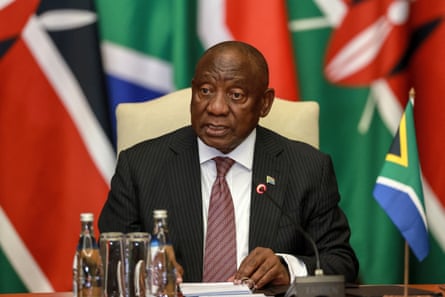
South Africa’s president, Cyril Ramaphosa, sits in front of various flags

Continue Reading‘Extreme fear’ among immigrants as backlash sweeps South Africa

Ebola spread in central Africa could match 2014 record outbreak, US health officials say

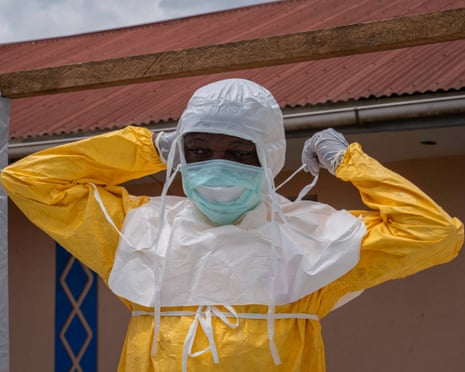
A doctor at an ebola treatment centre removes his personal protection equipment

Central Africa’s Ebola outbreak could spread to be similar in scale to the worst outbreak in history, west Africa’s 2014-2016 outbreak that killed more than 11,000 people, according to a new analysis by US health officials.

The US Centers for Disease Control and Prevention (CDC) on Friday published a range of scenarios generated by computer models, from 10,000 cases to more than 20,000. In the west Africa outbreak, more than 28,000 cases were reported.

The analysis from the CDC said cases could grow to 20,000 or more, depending on how quickly infected people are isolated to slow the spread.

Incident manager for the CDC’s Ebola response, Dr Satish Pillai, said without strong public health interventions, “the modelling work suggests an outbreak of that scale is possible”.

Jennifer Nuzzo, director of Brown University’s Pandemic Center in the United States, said the modelling “affirms what we have worried about since the beginning: this outbreak is following dangerous trajectory” if more is not done to stop its spread.

But she cautioned it can be extremely difficult to predict how outbreaks will progress. “I wouldn’t read too much into the specific numbers. It’s really hard to make an accurate projection when you have limited data,” she said.

The Africa Centers for Disease Control and Prevention said Friday there have been about 400 confirmed cases, including 63 deaths. Experts say there are probably other cases that haven’t been diagnosed or reported.

The viruses that cause Ebola are spread through contact with body fluid such as vomit, blood and semen. There are no specific treatments or vaccines for the Bundibugyo virus at the heart of the current outbreak. The disease is often fatal.

The World Health Organization declared the outbreak a global health emergency in May. Some experts believe infections may have been occurring in February, but health officials initially tested for a different kind of Ebola virus.

The outbreak response has been complicated by an armed conflict between Congo’s government and the Rwanda-backed M23 rebel group, as well as attacks by the Islamic State-affiliated group the Allied Democratic Force. The violence has caused massive displacement of people living in the conflict areas, officials say.

CDC’s modelling report attempts to project how things might play out, based on different factors – including how many infections and deaths have already happened, and how quickly responders can identify and isolate infected people before they can spread the infection to others.

Pillai said the actual isolation rate is unknown but is considered to be “on the lower end of the scenarios” that CDC modelled.

Higher isolation rates, of 50% or 70%, could result in the number of cases being more like 10,000, CDC officials said. But if the actual number of deaths were greater in late May than now recognised, that could make the outcomes worse, CDC officials said.

Some CDC modelling during the large Ebola outbreak in West Africa proved to be way off. The CDC issued modelled numbers in 2014, when the epidemic was spiralling out of control and international health officials were quickly trying to build a response.

It estimated that in a worse-case scenario where nothing was done, as many as 1.4 million people might become infected. That turned out to be more than 50 times higher than what happened.

Continue ReadingEbola spread in central Africa could match 2014 record outbreak, US health officials say

‘Family values’ African charter condemned by rights groups as regressive and dangerous

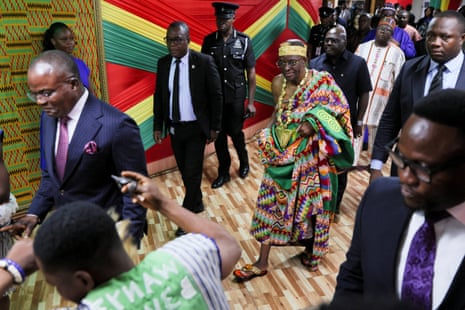
An older African man in colourful traditional Ghanian robe, necklace and kufi hat leads a procession attended by officials
theguardian.org

An African treaty that rejects longstanding international human rights obligations moved a step closer to becoming policy this week as governments across the continent met in Ghana.

The draft African charter on family, sovereignty and values, seen by the Guardian, asserts that African values and culture are under attack from “foreign ideologies” and urges states to withdraw from any agreements that do not align with the principles of the charter, including the 2003 Maputo protocol, which promotes gender equality and protects the reproductive and health rights of women and girls.

The charter is the first attempt to impose a continent-wide legal framework rooted in a moralistic rather than rights-based viewpoint. It claims that sexual and reproductive health and rights are an existential threat to the African family, and falsely states that policies based on these rights promote abortion on demand.

The draft treaty also rejects comprehensive sex education (CSE), which it claims sexualises children; asserts that gender is either male or female; and declares that parental rights override a child’s rights, including on decisions about sexuality and discipline.

African legal experts, reproductive rights groups and LGBTQ+ advocates have condemned the charter as regressive and dangerous.

Gilbert Mitullah, a Kenyan lawyer and board member at the Queer African Network, said: “It is a licence to oppose, regress on or refuse to implement existing commitments on sexual and reproductive health, and on LGBTQ rights, and to dismantle the Maputo protocol from within. That is its operational function, even before any signature is placed on it.”

The charter was drawn up by a core group of African lawmakers, led by Ugandan government ministers, at the annual inter-parliamentary conference on family values and sovereignty, a controversial meeting that has become known for shaping anti-homosexuality legislation.

The objective of the 2026 conference, which was held in Ghana for the first time this week and attended by representatives from 20 countries, was to advance the charter by garnering enough support to take it to the African Union general assembly next February, when it would be put to a vote.

Critics say the charter’s definition of family based strictly on heterosexual marriage ignores the huge diversity of families across the continent’s 54 countries.

In an extensive analysis of the draft, the Initiative for Strategic Litigation in Africa (ISLA), a pan-African feminist initiative, argues that prioritising the family over the individual “risks legitimising the subordination of women, children and adolescents to collective family interests and insulating private family relations from state accountability, especially in situations involving violence, coercion, or discrimination”.

Lakshita Kanhiya, a legal officer at ISLA, said: “Women will no longer be safe; children will not be safe.”

Mitullah said: “‘Family values’ rhetoric does two things at once. It legitimises expanded state intrusion into private life, and it provides a vocabulary that wins votes without delivering material change.”

The ISLA report also criticises the way legitimate concerns around sovereignty and colonialism are distorted. The terminology running through the charter exposes the strong influence of conservative Christian organisations from the US and Europe that oppose abortion and LGBTQ+ rights. Progressive policies are dismissed as neocolonialism or cultural imperialism.

Famia Nkansa, communications lead at Purposeful, a Sierra Leone-based organisation focused on girls’ activism, said: “Anti-rights activity on the continent is simply an extension and expansion of the same colonial playbook: Africa serving as a battleground on which the west wages its ideological and economic wars.”

According to the US-based international reproductive rights organisation Ipas, the annual conferences have been supported by Family Watch International, an Arizona-based Christian lobbying organisation that opposes abortion and runs an anti-CSE campaign. Sharon Slater, FWI’s co-founder, has repeatedly claimed that the UN and western donor nations are imposing a “radical sexual rights agenda”.

Mitullah said: “The charter is not a continental instrument that happens to share vocabulary with western anti-rights groups. It is a transplant.”

He added that the Geneva Consensus Declaration, an anti-abortion manifesto crafted by the former Trump adviser Valerie Huber, was cited in the text, describing the document as a “collaborative product of a transnational network, with African signatories used to give it the appearance of Indigenous provenance”.

In a statement, FWI said it was not participating in or a sponsor of the conference in Ghana.

“The draft charter is Africa-inspired, African-initiated, and African-directed and controlled,” it said, but added: “That being said, FWI strongly supports the draft charter’s restrictions on the dissemination of harmful CSE programmes in Africa, given their propensity to sexualise children. We also strongly support the provisions encouraging governments to use a family lens when developing and implementing laws, policies and programmes.”

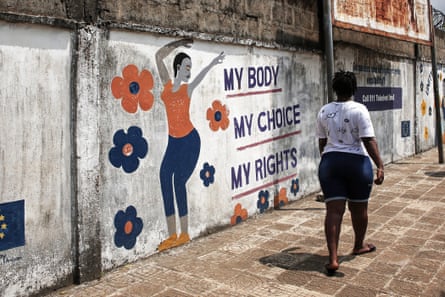
A woman walks past a mural with a painting of a woman and a slogan that reads ‘My Body, My Choice, My Rights’
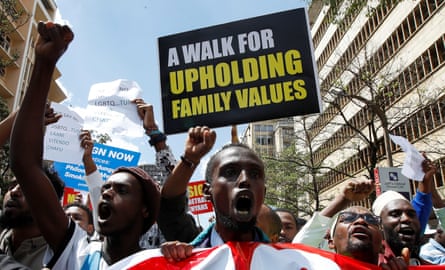
African men demonstrators shouting and waving placards, one of which reads: ‘A walk for upholding family values’

Continue Reading‘Family values’ African charter condemned by rights groups as regressive and dangerous

Experts criticise plan for American-only Ebola quarantine centre in Kenya

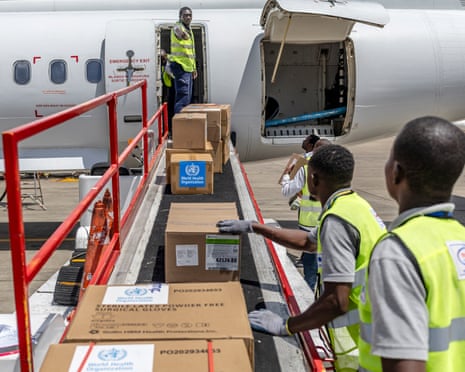
Airport crew in hi-vis jackets push supplies in cardboard boxes up a conveyor belt loading the hull of a plane

Former top US officials and other experts are urging the Trump administration to abandon plans for an Ebola quarantine and treatment centre in Kenya, as the union for workers with the US Centers for Disease Control and Prevention (CDC) calls for Americans exposed to Ebola to be brought home for treatment.

Soon after the US revealed it was setting up a field hospital in Kenya for the Ebola quarantine and treatment of Americans, the Kenyan high court blocked the order – but the Kenyan and US governments moved forward anyway, with the first American responders reportedly landing at the Laikipia airbase on Saturday.

Several former US health leaders, including previous top-level CDC officials, laid out their objections in a letter to Congress. “This policy raises profound clinical, ethical, operational and legal concerns,” they wrote.

Daniel Jernigan, who spent 31 years at the CDC, including overseeing the agency’s Ebola response in 2014-15, before resigning last year, said it was not clear how current officials had arrived at this plan “because it’s against so many ethical underpinnings that we have relied on for all of the past responses”.

The US is in the process of building a 50-bed unit at the airbase. Patients would have access to medications and some respiratory support, but those needing higher levels of care would be flown to as-yet unidentified hospitals in Europe.

Yolanda Jacobs, the president of the AFGE Local 2883 government employees’ union, said in a statement that the Trump administration was “abandoning” CDC workers responding to the outbreak, in “a sharp departure from the standard upheld by every previous administration”.

The White House did not respond to inquires about whether the facility would be accessible to Kenyans and others working on the Ebola response, and whether all Americans working on the Ebola response would be required to quarantine or whether it would be required only of Americans with high-risk exposures. Previously, the White House did not say whether Americans wishing to return home rather than going to Kenya would be allowed to do so.

The US Department of Health and Human Services referred inquiries to the state department, which has been approached for comment. Last week the US secretary of state, Marco Rubio, said: “We cannot and will not allow any cases of Ebola to enter the United States.”.

During the 2014 Ebola epidemic in west Africa, several people treating patients were safely evacuated to and treated at US facilities in Atlanta, Bethesda, Omaha and New York, with no onward transmission. The US president, Donald Trump, vehemently opposed the move at the time, saying that returning volunteers “must suffer the consequences” and should not be allowed into the US.

Ronald Nahass, the president of the Infectious Diseases Society of America and the medical director of research at ID Care, said Americans could safely quarantine in place after a high-risk exposure to Ebola, and that if they developed symptoms, the US had some of the best quarantine and treatment facilities in the world.

“We’ve spent taxpayer dollars to create some really first-class biocontainment units to specifically address this type of an issue and have trained staff who are extraordinarily expert in dealing with this,” Nahass said. Those facilities “can handle it in a better way than a field hospital in Kenya”, he added. “Why wouldn’t you evacuate American citizens if you’re concerned?”

During the 2014 outbreak, the US created a field hospital specifically for health workers from all countries who might need Ebola care. “If you come over to west Africa to help, we’ve got your back,” Jernigan said of the 2014 approach. Creating a quarantine centre in another country for Americans only would be highly unusual and a major reversal from such plans, he said.

It is also not clear what would happen to Americans in quarantine if they needed outside medical care for non-Ebola causes, such as a heart attack or appendicitis, Jernigan said. “Are you going to send them to Kenyatta hospital in Nairobi, and if so, are you going to send them in a bubble and have a dedicated ward there? If you would just send them back to the United States to a designated facility that has already been established with millions of dollars to do it, they’re surrounded by specialists.”

Travel bans and restrictions such as these were ineffective at stopping the spread of disease, Nahass said. “Borders are porous, you can’t keep infectious diseases out of the country” in this way, he said. Instead, Nahass said, tried-and-true public health measures such as monitoring potential exposures and making sure health care providers are prepared for potential cases wooould be much more effective.

International collaboration is also crucial for controlling outbreaks, Nahass said. “​These are global events and not being part of the global discussion in which the platform for that is the WHO [World Health Organization] is problematic.” America’s absence on the world stage is notable and will have lasting repercussions, he added.

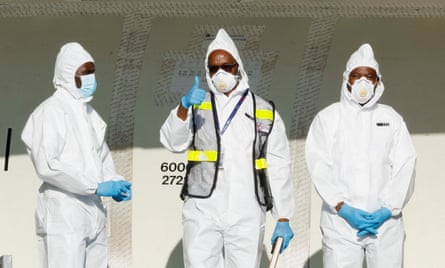
ECHO crew give the photographer a thumbs-up while dressed in plain white PPE suits and face masks

Continue ReadingExperts criticise plan for American-only Ebola quarantine centre in Kenya

Civilians flee Mogadishu as Somali troops and opposition-allied militias trade fire

People watch as a pickup truck carrying men in the back with weapons drives along a road.

Government troops and militias allied with the opposition have exchanged fire in Somalia’s capital, Mogadishu, damaging property and forcing some civilians to flee.

The violence flared up ahead of planned protests on Thursday over president Hassan Sheikh Mohamud’s decision to remain in office after his term expired in May. In March, parliament backed constitutional changes that could allow Mohamud to extend his term by a year and push back an election.

The ormer president Sharif Sheikh Ahmed, who was in power from 2009 to 2012, said government forces had targeted his home, and accused Mohamud’s government of “illegally altering the constitution”.

“The government forces encircled and attacked my house. I am never scared of their aggressive attack, I will fight back,” he said in a video on his Facebook account posted overnight.

In a post on X, the former prime minister Hassan Ali Khaire accused government troops of using heavy weapons including anti-tank weapons and drones in a densely populated area. Khaire added that the government had directed “a sustained and indiscriminate military assault” aimed at killing him and Ahmed.

Somalia’s information and defence ministers did not pick up calls or respond to Reuters’ messages seeking comment.

Fighting began around 5pm on Wednesday and continued into Thursday morning, with thousands of government troops deployed in Mogadishu’s Howl Wadag and Abdiasis districts, where they traded fire with militias supporting opposition leaders, residents told Reuters.

One resident, Ahmed Ismail, told Reuters early on Thursday: “A mortar shell landed on my neighbour’s house, injuring a mother. A big house near us is also ablaze, mortars and other weapons landed on it.

“In front of our house I see a man injured and carried by hand. Civilians keep on fleeing the war, I see them walking with kids in hand and cursing the two warring groups.”

At least two armoured vehicles were burned by opposition-allied militias, Mohamud Farah, another witness, said.

Somalia has endured conflict and clan battles with no strong central government since the fall of the autocratic ruler Mohamed Siad Barre in 1991. The country has also been grappling with a nearly two decade-long insurgency led by the al-Qaida-linked al-Shabaab group.

The US embassy in Mogadishu described the violence as “reckless”. “Somali leaders on all sides have a responsibility to preserve stability and resolve differences through peaceful means,” it said in a post on X.

The UK also urged restraint and dialogue, saying the violence was unacceptable.

Somalia’s president, Hassan Sheikh Mohamud.

Continue ReadingCivilians flee Mogadishu as Somali troops and opposition-allied militias trade fire