Understanding Ebola’s wildlife origins is crucial to preventing next big outbreak

Healthcare workers in protective suits and blue gloves close the coffin of an Ebola victim.

While virologists and public health departments were palpitating over the news of an Andes virus infectious disease outbreak on a cruise ship (13 cases, three deaths), in the Democratic Republic of the Congo the Bundibugyo virus, the root of the current Ebola outbreak (currently more than 1,250 cases and at least 362 deaths), was smouldering under the radar.

Bundibugyo virus is a horrifying, highly fatal pathogen. Symptom onset is sudden and includes headaches, diarrhoea, malfunctioning kidneys and liver, and, less frequently, internal and external bleeding (hence the term “haemorrhagic disease”). Grimly, contagiousness remains after death, meaning the family and loved ones of the deceased can be exposed when they wash and clothe the body in preparation for the funeral.

The priority right now is to dedicate resources to fight the outbreak. Without a proven established vaccine, health workers will have to combat disease spread by isolating patients and tracing contacts who may have been exposed.

But when the outbreak is controlled, it will be time to ask two questions: why did this outbreak happen? And where did the disease come from? The answers are critical to try to prevent or mitigate the next outbreak.

The virus is a relative of the more infamous Zaire Ebola virus that has sporadically caused outbreaks of Ebola virus disease in remote African rainforests since the 1970s, but exploded spectacularly to cause a pandemic in west Africa from 2014 to 2016.

Terrifyingly, even though Ebola viruses are highly ranked on lists of bio-terror agents, we know very little about these viruses in the wild. Marburg virus, a more distantly related haemorrhagic fever virus, is known to persist in large fruit bats, and this has generated the reasonable but unproven assumption that bats are the reservoir hosts for the rest of the Ebola virus family.

Fruit bats are widespread, abundant, large and conspicuous animals and are easily blamed as a source for each Ebola virus outbreak. Yet proof that bats are viable incubators of the Zaire Ebola virus remains frustratingly elusive. Arguing that bats are the source of Bundibugyo virus is currently just conjecture. Having a distant cousin who wears a kilt doesn’t make you Scottish.

In fact, historically, the first human cases in Ebola virus outbreaks were linked to exposure to other mammal species: forest antelopes, gorillas and chimpanzees. Experimentally infected pigs can shed infectious Ebola viruses and can infect primates. So it appears that Ebola viruses have a varied approach when it comes to host animals. It’s also possible the virus can hide away in the same host for years before recrudescing, a mechanism that could explain the long periods when Ebola viruses seem to vanish without trace.

How then would you go about determining Bundibugyo virus transmission patterns in tropical forest? How do you convince a group of wary canopy-dwelling monkeys to provide samples? Capture them? Shoot them? Analyse their faeces? Or should you target herds of bush pigs? Or giant fruit bats? Or all of the above? And if this disease is rare, and outbreaks in humans occur after the disease has spilled from wildlife, then how on earth do you capture the virus red-handed?

These issues make muddy waters for understanding how diseases emerge; just look at the controversies surrounding the origins of Covid-19. And now imagine attempting this kind of scientific research in an area of political unrest, and in the face of ruthless cost-cutting of research and health funds by the US and UK and the consequent evaporation of infrastructure.

Yet these questions need to be answered. Before 2010, the largest Ebola virus outbreaks rarely exceeded 300 cases, but since then there have been three outbreaks where cases are counted in the thousands. The trend is indubitably one of larger epidemics.

If we knew how Ebola viruses worked, we could mitigate against them by reducing human exposure, whether it be using wildland buffers or discouraging consumption of wild animals. Or we could adopt integrated surveillance programmes that look for signs of disease spread among wildlife, livestock and humans.

The problem is, if we don’t know the source, not only do humans remain at risk but local wildlife can also suffer needlessly via retaliations against perceived wildlife culprits, like the bat-killing sprees in the aftermath of Covid-19: in Cuba, people set fire to roosts; in Rwanda, government workers aimed water cannon at bats; and in many other countries bat roosts were attacked and destroyed.

This kind of action will achieve nothing for human health if the species is unrelated to the pathogen’s transmission, and disturbing or culling wildlife populations can unintentionally exacerbate disease spread, whether it’s Marburg virus, rabies or bovine tuberculosis. And if habitat destruction is the driver of recurrent Ebola virus outbreaks, Bundibugyo or otherwise, we ought to get smarter at answering these questions.

These links between humans, wildlife and environment are cruxes of the so-called “one health” approach, explicitly recognising the connections and how that might affect the health of all three components.

The interwoven implication is that optimising health for one element can simultaneously boost health in another. It’s not a concept that is limited to Bundibugyo. It can be locally applied anywhere: chicken farms and wild swimming in the Wye or bovine tuberculosis in badgers and cows. The burning question is whether this outbreak might provide the incentive to act to try to prevent future epidemics.

Dan Salkeld is a disease ecologist and the author of Emerging Zoonotic and Wildlife Pathogens
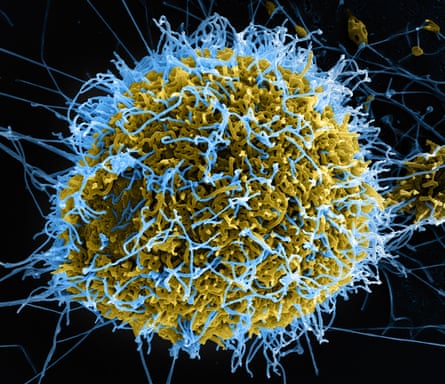
Ebola virus
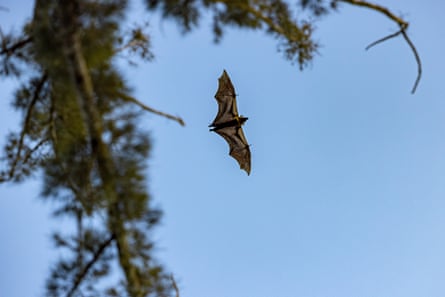
A fruit bat flies around a tree in Mongbwalu, Democratic Republic of Congo.
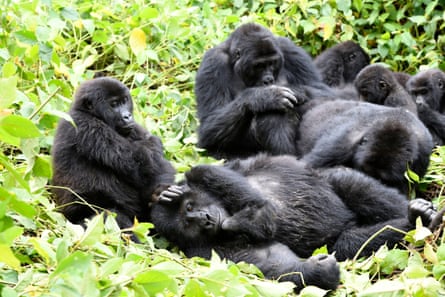
Group of gorillas in Kahuzi Biega National Park.

Continue ReadingUnderstanding Ebola’s wildlife origins is crucial to preventing next big outbreak

Sudan’s RSF committed crimes against humanity in El Fasher, Amnesty says

Armed fighters in camouflage and face coverings hold rifles in an outdoor area with vehicles and vegetation

The Sudanese paramilitary Rapid Support Forces committed crimes against humanity and ethnic cleansing during its seizure of El Fasher last year, Amnesty International has alleged.

Many of the crimes, including murder, torture, rape, enslavement and sexual slavery, were carried out as part of a widespread and systematic attack against civilians and amounted to crimes against humanity, the human rights organisation said in a report released on Wednesday.

In the report, Amnesty also accused the RSF of deliberately targeting children during attacks in the city in North Darfur state.

In late October, the paramilitary force captured El Fasher, the last stronghold of the Sudan armed forces in the Darfur region, after an 18-month siege. The brutal takeover was marked by widespread massacres, with tens of thousands of people killed.

In February, an independent fact-finding mission for the UN said the RSF’s seizure of El Fasher showed “hallmarks of genocide” against non-Arab communities.

For the report, Amnesty interviewed 247 people, including 208 survivors of the fighting in the city and surrounding areas. It also analysed documentary and video material, and carried out analysis of satellite imagery from North Darfur.

Amnesty concluded that the RSF had committed war crimes in El Fasher and surrounding areas between mid-2024 and late 2025. It found the paramilitary force had often targeted non-Arab civilians and repeatedly used derogatory and dehumanising language in attacks. The RSF committed the crime against humanity of persecution on the basis of ethnicity, Amnesty concluded.

The human rights organisation said RSF’s destruction of towns and villages between December 2024 and March 2025 including Abu Zerega, which is populated by non-Arab ethnic groups, was consistent with ethnic cleansing.

The report said the abuses carried out by the paramilitary force had orphaned countless children and displaced hundreds of thousands of others, exposing them to death and injury during attacks or while fleeing.

Agnès Callamard, the secretary general of Amnesty International, said: “The war in Sudan is a war on civilians. The world was warned of the horrors that civilians in El Fasher confronted as the RSF laid siege to the city. It is a stain on the conscience of humanity.”

The report named three RSF commanders whom it said were responsible for serious violations of international law: Maj Gen Gedo Hamdan Ahmed Mohamed, also known as “Abu Shok”, Lt Col Abbas Khater Bakhit and commander Al-Fateh Abdullah Idris, also known as “Abu Lulu”.

The Sudanese civil war began in April 2023 when a power struggle between the Sudan armed forces led by Gen Abdel Fattah al-Burhan and the RSF headed by Gen Mohamed Hamdan Dagalo, commonly known as Hemedti, erupted into violence in the capital, Khartoum.

The fighting has killed hundreds of thousands of people and displaced more.

Amnesty called for an immediate ceasefire and for the urgent deployment of an international force to protect civilians.

Callamard said: “The international community must move beyond statements of concern and take concrete steps to protect civilians, breaking the cycle of impunity.”

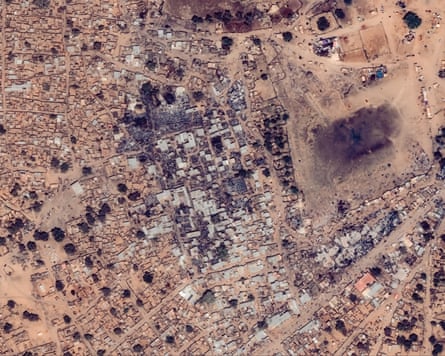
Satellite imagery shows the destruction in El Fasher.
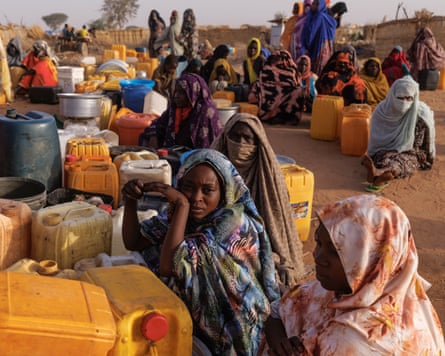
Refugees queuing for water

Continue ReadingSudan’s RSF committed crimes against humanity in El Fasher, Amnesty says

‘Witch-hunt’ in Niger as military regime rounds up LGBTQ+ population

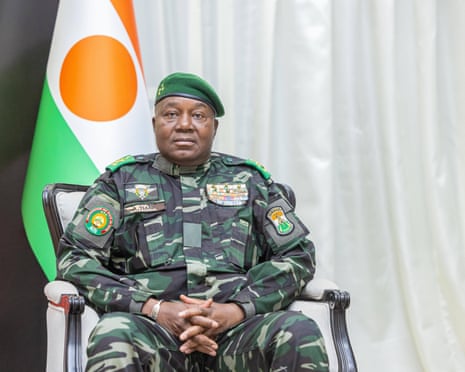
An older African man in camouflage fatigues and a beret sits by a green and orange flag
theguardian.org

A “witch-hunt” is under way in Niger, where dozens of people have been arrested for homosexuality in the west African state following the introduction of a new penal code earlier this year.

Up to 40 people have been arrested and 16 men, including high-ranking military officials, have been imprisoned across the country, according to local media.

Organisations providing HIV services to men who have sex with men have had to stop working, according to a source who asked to remain anonymous.

“With the recent witch-hunt, and these arrests that are taking place, the climate here is truly toxic,” they said.

“LGBTQ+ populations are keeping a low profile and have gone into hiding because they are at risk. We have lost contact with many and the recent arrests have exacerbated tensions.”

Niger’s new penal code, enacted in February, dictates that “indecent or unnatural acts” and “sexual relations with a person of the same sex” are punishable by imprisonment of up to 10 years and a fine of up to 100m West African CFA francs (£130,000).

It is the first time in the country’s history that homosexuality has been criminalised and follows the introduction of similar laws and penal codes in neighbouring Mali and Burkina Faso within the past two years.

Gen Abdourahamane Tiani, the head of the military government, seized power in a coup d’état in July 2023 and was sworn in as president in 2025 for a term of five years, dissolving all political parties in the country.

The former UN peacekeeper has pushed anti-imperialist rhetoric and formed the Alliance of Sahel States with Burkina Faso and Mali, breaking away from the Economic Community of West African States (Ecowas).

Larissa Kojoué, a political scientist and pan-African activist, dismissed the idea of homosexuality being somehow linked to western culture. “Political leaders are using this to advance their own political agenda,” she said. “They claim ‘African values’, sovereignty and culture, all the while happily undermining human rights for people.”

She added: “There is no culture that encourages violence against innocent people, or that doesn’t hold perpetrators of violence accountable. But on the [African] continent you can do whatever you want with LGBTQ+ people and get away with it.”

The changes to the penal code started under Niger’s previous civilian president, Mohamed Bazoum. But in March 2025, Tiani’s regime promulgated the Charter of the Refoundation to replace Niger’s 2010 constitution.

Although the charter prohibits LGBTQ+ relations, criminal penalties related to these measures were only introduced with the new penal code in February.

As well as harsh punishments for same-sex relations, it also mandates prison terms of up to 20 years for those participating in, witnessing or organising a gay marriage. Any person or organisation involved with clubs, societies or organisations for LGBTQ+ people, either directly or indirectly, is liable to be imprisoned for up to 20 years and face a fine of up to 500m CFA.

Men who have sex with men no longer have access to condoms, testing services or PrEP (medication protecting against HIV).

The anonymous source warned of the risk of HIV infections spreading, saying: “When people go into hiding, we won’t see them and they won’t be able to protect themselves. So you see the impact [this penal code] has. We are truly saddened by it.”

Last week, Niger was among eight countries that voted against the UN’s political declaration on HIV/Aids, which was adopted by 149 votes. HIV infections increased between 2010 and 2025 in the Middle East, north Africa, Latin America, eastern Europe and Central Asia, according to the declaration.

While western and central Africa has seen a 49% decline in new infections between 2010 and 2022, sub-Saharan Africa remains disproportionately affected, representing 64% of all people living with HIV globally. There were an estimated 32,000 new infections in Niger in 2023.

The reform of Niger’s penal code is part of a trend across sub-Saharan Africa towards more punitive legislation against LGBTQ+ people. In recent years several African states have introduced or strengthened laws criminalising same-sex relations.

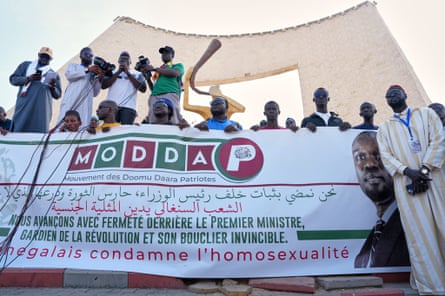
Examples include Uganda’s 2023 Anti-Homosexuality Act, which made homosexual acts punishable by death; a new law in Senegal doubling the maximum prison term to 10 years for same-sex relations and criminalising the “promotion” of homosexuality; and a bill in Ghana criminalising groups promoting gay rights and identifying as LGBTQ+. Globally, half of the 66 countries that criminalise consensual same-sex acts are African.

In a statement, the international human rights group Front Line Defenders said it was “deeply concerned” about developments in Niger, and called on authorities “to repeal all provisions that criminalise individuals on the basis of their sexual orientation or gender identity, as well as the individuals supporting and defending them”.

Senegalese men demonstrate in Dakar against LGBTQ+ rights.

Continue Reading‘Witch-hunt’ in Niger as military regime rounds up LGBTQ+ population

‘They will attack me if I stay’: immigrants in South Africa flee for safety amid violence and anti-foreigner protests

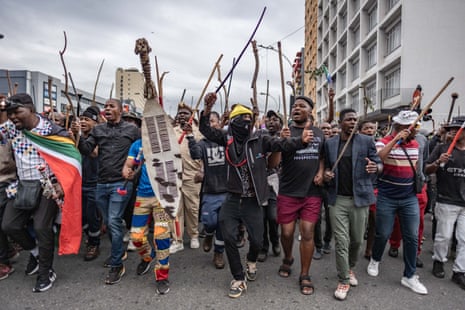
A group of protesters in Durban, South Africa holding clubs and bats
theguardian.org

South Africa was holding its breath on Tuesday as mass anti-immigration protests were held across the country. They come after a weeks-long campaign against foreigners that has seen at least four killed and tens of thousands fleeing for safety.

In the coastal city of Durban, where violence had been expected, the streets were unusually quiet and shops were shuttered as tension hung thick in the air.

More than 2,000 protesters in Zulu attire marched through the city centre, brandishing sticks and clubs and calling out “Abahambe!” (“They must go!” in isiZulu, the most widely spoken language in the country), a phrase that has become the movement’s rallying cry.

Campaign groups behind the protests have given undocumented immigrants an arbitrary “deadline” of 30 June to leave the country, with many fearing the marches could descend into violence.

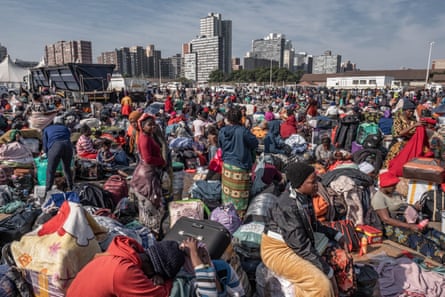
In the days leading up to the deadline, thousands of people have fled their homes in fear, sleeping rough on pavements, in open fields and in makeshift camps, in the hope of being repatriated to their home countries. Several African governments have organised buses or planes to bring their citizens home, with police saying more than 25,000 have been repatriated so far.

In the city of Pietermaritzburg, 50 miles from Durban, where a 29-year-old Malawian national was killed by a mob after a protest on 19 June, hundreds of families camped for days outside an abandoned building.

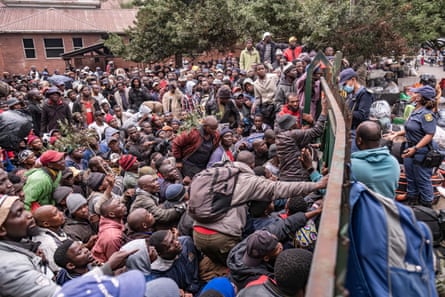
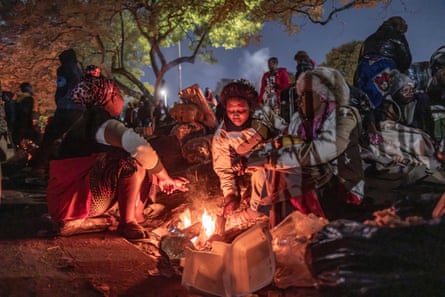
On the eve of the 30 June protests, as authorities raced to send home as many as possible, a queue snaked through the overgrown garden. Weary mothers and children sat around campfires while people lifted their tightly packed belongings into buses headed for South Africa’s northern border.

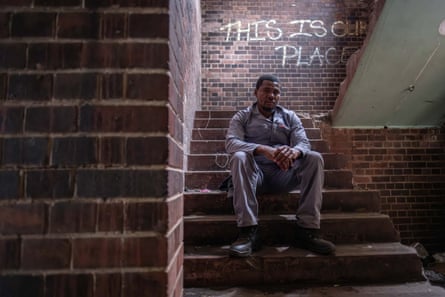
Jackson Makungwa stood in the line beside two small bags: everything he could carry from 10 years spent building a life in South Africa. The 29-year-old from Malawi had once seen South Africa as a “country of hope” and had lived there legally, but said he had been unable to renew his work permit for the past two years.

“It’s not like I want to be illegally in the country, but the system doesn’t allow me to be here legally,” he sighed.

For weeks, Makungwa resisted his mother’s growing pleas for him to leave. That changed after a friend from Malawi was attacked by seven men.

“They said the deadline is the 30th, so they will attack me if I stay,” Makungwa said.

On his phone, he showed a photo of his son, born to a South African mother. He hadn’t managed to secure travel documents for the baby in time. “I was forced to leave him behind. He turns two months old today.”

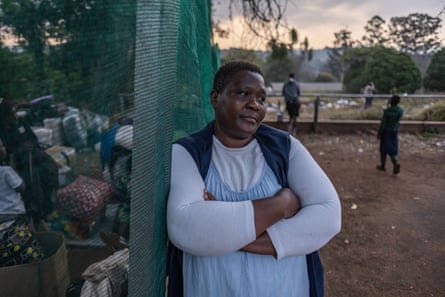
Down the road, in a makeshift camp set up by families from Zimbabwe, Lydia Mpingashato had just been informed of her dismissal from her job as a cleaner. Children ran around as women cooked on open fires. Many – including people with legal documentation – said they had been evicted by landlords who feared retaliation for renting to immigrants.

On 27 June, Mpingashato was threatened while waiting for a shared taxi in the township where she had lived for 17 years. “He said he would burn my house and kill my family,” she said. “Now I have no plan; I’m just going home to be safe.”

Her 17-year-old son had been forced to leave the only home he had ever known, as well as many South African friends, she said. “When he saw the camp, he told me: ‘Actually, they never loved us.’”

Many in South Africa blame immigrants from elsewhere on the continent for the country’s high unemployment rate and crime levels. “Xenophobia and Afrophobia … emerge where economic insecurity, high unemployment, inequality, weak governance and poor migration management intersect,” says Philile Ntuli from the South African Human Rights Commission.

The country, which is home to about 2.4 million foreigners (documented and undocumented) according to 2022 census data, has a long history of anti-immigrant violence. Xenophobic riots in 2008 killed 62 people and displaced more than 150,000. Another wave of attacks in 2015 left at least five people dead.

In response to the latest tensions, the government has sought to ease public anger by intensifying its crackdown on undocumented immigration. Police say more than 50,000 undocumented migrants have been arrested since January. On Monday night, President Cyril Ramaphosa met some of the protest leaders and warned against “vigilantism”.

As marches began across the country, a heavy security deployment was visible as authorities prepared for possible unrest. In Durban, helicopters circled overhead while police and private security watched from armoured vehicles. Organisers urged protesters to remain peaceful and avoid looting, but some marchers made thinly veiled threats about what would happen after the “deadline”.

As the crowd moved past dilapidated apartment blocks, some protesters pointed at families watching from windows, calling out for them to leave the country and making throat-slitting gestures. “I can smell the foreigners,” said a man carrying a shield.

“We have been talking nicely. Tomorrow, we’re not going to talk. We take action,” said Nkosi Ndlovu, a 48-year-old pastor who accused immigrants of selling drugs to local young people, including his sister-in-law.

On the outskirts of the march, 40-year-old Mfundo Zulu said immigrants were taking jobs from South Africans by accepting lower wages. “Those are our kids, our youth are dead,” she said, pointing towards a nearby homeless camp. Since thousands of people had fled the country in recent weeks, she said, many jobs had suddenly become available.

“Life will be better now,” her friend added. “We don’t hate them, but they overstayed.”

For Mukandjwa Shomri of the Southern Africa Refugee Organisations Forum, South Africa’s government “is not doing enough” to hold perpetrators of xenophobic violence accountable. “When you try to open a case with the police, they will first ask for your papers,” he said. “We are being attacked in the streets, in the community and administratively.

“The hope many of us had as refugees when we came to this country – that South Africa is upholding human rights, a country affirmed internationally as a democratic state, is no longer there,” he said.

Speaking on the phone from a safe house, Leon feared what would happen after the 30 June cutoff. The asylum seeker from the Democratic Republic of the Congo, who has been in South Africa since 2014, went into hiding after his shop was attacked on 19 June. He asked to be identified only by his first name.

“Even the police are telling us openly that we are tired of you, you must leave our country,” he said, his voice trembling. Harassment had already been commonplace for years, “but now they got the opportunity to do it openly”, he said. “After 30 June, it will be even worse.”

Some days, Leon regretted seeking refuge in South Africa, a country where he thought he would find peace. “Now, we’re just living like somebody who is already dead,” he said.

“We are ready for anything.”

Malawian migrants in Durban wait to board buses at a makeshift displacement camp.
Jackson Makungwa, a migrant from Malawi, forced to leave his partner and two-month-old baby.
Lydia Mpingashato, a Zimbabwean migrant, photographed at a makeshift camp in Pietermaritzburg.
Malawian migrants fleeing Pietermaritzburg, South Africa.
A makeshift displacement camp in Pietermaritzburg, South Africa.

Continue Reading‘They will attack me if I stay’: immigrants in South Africa flee for safety amid violence and anti-foreigner protests

Police units deployed across South Africa before anti-immigration marches

Crowd of people waving South Africa flags

South African authorities have deployed police units to towns and cities around the country before planned demonstrations against undocumented foreign nationals.

Security personnel were seen patrolling the central business district in Johannesburg, the economic capital, where many shopkeepers decided not to open on Tuesday. Trucks and other assets belonging to the South African National Defence Force were also present, according to local media reports.

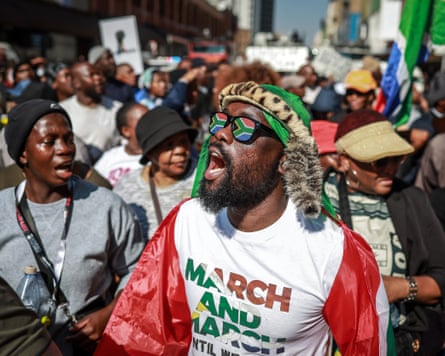
The protests have been organised by anti-migration vigilante groups, including March and March, who set an unofficial 30 June deadline for undocumented foreigners to leave the country. Organisers insist they are focused on undocumented migrants and will demonstrate peacefully, but foreigners with documentation have also complained of targeted harassment.

“We are not calling for violence … No one will be killed on 30 June and no looting will take place in our name,” said Jacinta Ngobese-Zuma, the leader of March and March.

The police deployment is seen as an attempt to prevent mass-scale looting and mob violence, similar to the 2008 anti-migrant riots that left 62 people dead. In July 2021, more than 350 people were killed in the country’s deadliest unrest since the end of apartheid, after the former president Jacob Zuma was jailed for contempt of court.

For weeks this May and June, men carrying sticks and chanting “abahambe” (an isiZulu and isiXhosa word meaning “they must leave”) have been seen going from shops to shops, interrogating and in certain cases beating up migrants across Johannesburg and Durban. So far, five Mozambican nationals have been killed, according to a statement from South Africa’s north-eastern neighbour.

Foreign-born migrants make up an estimated 4% of South Africa’s 62 million people, despite claims that they number as many as 15-20 million. Many migrants work in the informal sector, as economic strain in neighbouring countries has caused thousands to seek work in one of Africa’s largest economies.

Crime statistics show that only a small fraction of crimes are committed by foreigners, undermining a popular narrative by protest organisers. But in a country with one of the world’s highest unemployment rates and where wealth is concentrated in the hands of the country’s white minority, African migrants are sometimes treated as a scapegoat.

Authorities have been accused of responding meekly as the violence has gone largely unchecked. “There is no place for racism, sexism, tribalism, xenophobia, Afrophobia or any other form of intolerance,” the South African president, Cyril Ramaphosa, said in a recent forum with traditional monarchs.

Several governments including Nigeria, Ghana, Malawi and Uganda have repatriated hundreds of their citizens before the deadline, with some still stranded in South Africa. On social media, footage has emerged of dozens of Malawians camped in the cold outside their consulate in Johannesburg, waiting for processing and transport out of the country before the expiration of the deadline.

Man wearing South Africa flag sunglasses and a March and March T-shirt shouting in a crowd


Continue ReadingPolice units deployed across South Africa before anti-immigration marches

‘Everyone is talking about Cape Verde’: World Cup run delights diaspora community in UK

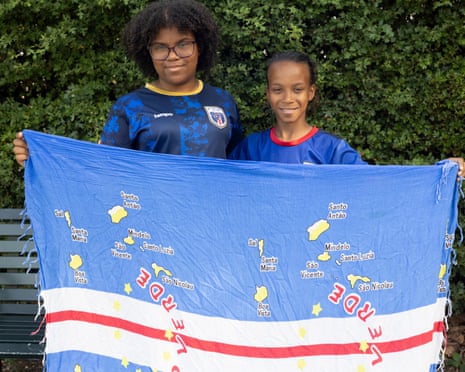
Two young people hold up a Cape Verde flag in front of greenery
Aamna Mohdin

For as long as she can remember, 13-year-old Lauryn struggled to find a map that included Cape Verde. Now, to her great delight, the tiny African island nation is finally centre stage.

“Seeing our country shown across the world at the World Cup makes me feel incredibly proud,” Lauryn says. “After the first match, everyone was talking about Cape Verde. People saw the talent and the skill of our players.”

Cape Verde, or Cabo Verde as the diaspora community in the UK knows it, are having a historic run at their first ever World Cup. The African nation, made up of 10 islands, has defied expectations by holding its own against the tournament’s leading teams.

Located in the Atlantic Ocean about 370 miles (600km) off the coast of mainland Africa, and with a population of just over 500,000, it is one of the smallest nations to compete at the tournament.

Lauryn, who has already published her first book, Unsung, says she scrolled through social media before Cape Verde’s opening match against Spain. “There were lots of posts on social media saying Cape Verde only had a 1% chance of winning. But after everyone saw our goalkeeper’s performance, everything changed.”

That 1% prediction has since become a rallying cry for the Cape Verdean diaspora in Britain, which is estimated to number in the low thousands. “Our slogan in the Cape Verdean community became: ‘They gave us 1% chance, but we had 99% faith,’” Lauryn says.

The team held a stunned Spain to a 0-0 draw. Their next match, against Uruguay, felt like a “constant heart attack”, says Annabella Lopes of the Cape Verdean Association UK. The game ended 2-2.

Now, the team, quickly becoming fans’ favourite underdogs, face Saudi Arabia in their final group stage match, which kicks off at 9pm ET on Friday in Houston, Texas – or 1am Saturday for Lauryn and others watching in the UK. A win will secure them a historic spot in the knockouts, while a draw will give them a fighting chance to qualify as one of the eight best third-placed teams.

Lauryn’s younger brother, 10-year-old Joylen, who plays football for Chelsea’s academy, says watching the tournament has strengthened his belief in the team. “I think we can definitely go very far. I knew people shouldn’t underestimate us because if we can draw against Spain and Uruguay, imagine what we can do against other teams.”

It has also inspired his own ambition. “It makes me want to reach my highest level,” he says.

For Lopes, the team’s performance sends a powerful message to the Cape Verde diaspora community across the world, as well as those who hail from small countries. “The success happening on the pitch reflects the resilience and strength of our people,” she says. “The fact that you are small, and the fact that people don’t know you, doesn’t mean you can’t achieve great things.”

She adds that it is not about winning or losing. “The important thing is to take part. Cape Verde is taking part, Cape Verde is competing, Cape Verde is achieving, and Cape Verde is making history.”

Much of the admiration has centred on the veteran goalkeeper Vozinha, whose Instagram page went from hundreds of thousands to nearly 10 million followers over the space of two games.

Nancy Rodrigues, a 38-year-old NHS physiotherapist living in the UK, says she treated the “really nice” goalkeeper when living in Angola. “He definitely deserves all the attention he’s getting now,” she says. “It’s amazing because everyone knows Cape Verde through him. That feels incredible.”

Elisangela, a 36-year-old accountant, known as Elly, says the team’s success has electrified the diaspora community across the world. “We have never experienced a moment like this before. Everyone is excited. People are calling each other, checking in and asking how they’re feeling and how they’re living through this moment with their families and friends.”

Lauryn and Joylen’s mother, Christina, hopes the team’s success leads to interest in the country that goes much further than football. “We are creative people. There is so much talent, not only in football but also in music, literature and the arts.”

She says she is particularly proud of the values and resilience the team is showing on the world stage, and points to the Cape Verde manager, Bubista, and his tradition of giving a gift to the coach of the opposing team before the start of each game.

“That’s part of who we are. We come as warriors on the pitch, but we honour and respect one another,” she says. “I think that’s what people are seeing. They’re not seeing arrogance. They’re seeing humility, unity and men crying because they care so much. It’s beautiful.”

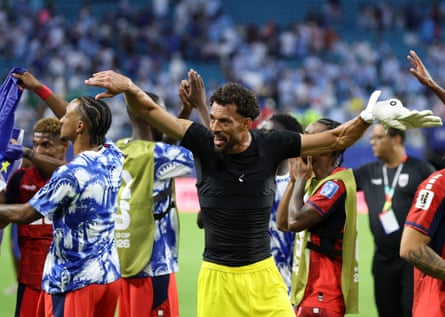
Goalkeeper Vozinha celebrates after Cape Verde’s draw with Uruguay
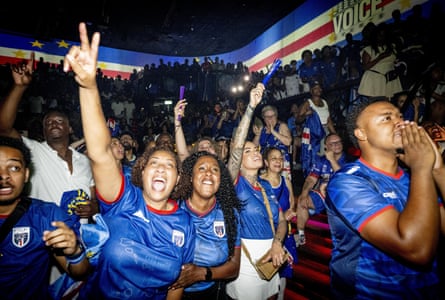
Cape Verde supporters in Rotterdam in the Netherlands


Continue Reading‘Everyone is talking about Cape Verde’: World Cup run delights diaspora community in UK