‘Blatant disregard for rights’: concern grows over Gabon’s social media clampdown

Closeup of young woman holding handwritten placard covering face with eyes showing above

When Gabon’s media regulator indefinitely suspended major social media platforms in February, citing security concerns during anti-government protests, it became the talk of town – literally.

Within weeks of the announcement, use of Virtual Private Networks (VPNs) to bypass the restrictions surged in the central African country. When gendarmerie began stopping young men at road checkpoints in the capital Libreville and other urban centres to confiscate mobile phones with VPNs installed or detain the owners, warnings spread by word of mouth. Activists and opposition members said their accounts were also suspended due to efforts of state officials.

Social media had helped citizens convene and stay informed since December, when workers in the education and health sectors protested over pay and the cost of living crisis. The government cited misinformation, disinformation, pornographic content, and incitement to hatred as reasons for the shutdown.

Rights groups have urged authorities to follow due process to prosecute any offenders, rather than collective punishment through unconstitutional restriction of freedom of expression.

“This sustained intentional interference with access to essential digital communication platforms in Gabon is a blatant disregard for people’s fundamental rights, specifically the freedom of expression and the right to access information,” said Felicia Anthonio, campaign manager at the #KeepItOn coalition — a global alliance of hundreds of human rights groups.

Nelly Ngabima, a controversial activist also known as Princesse de Souba, said she received threats from Gabonese government officials that they would make her “disappear from social networks”. Within a couple of months, her accounts with a combined following of over 300,000 across Facebook, YouTube and TikTok, had been suspended.

“They create fake accounts and they put our identities on those accounts, then they report us for identity theft,” she said. “Today, Gabonese people even struggle to send a WhatsApp message because they are afraid. They do not even go out with their phones.”

The restrictions were temporarily lifted in April. However, a new regulation passed in February mandates social media users to provide verified names, addresses and ID numbers. Social networks are at risk of 50m central African CFA franc (£66,000) fines and prison terms for non-compliance.

The law is one of a number of far-reaching changes to codify a crackdown on dissent including a controversial new nationality code signed in February and published last month. The code has come under criticism from those who say it restricts the rights of naturalised citizens and makes it easier for the state to strip citizens of their nationality.

“What is being said here and there, in my view and humble opinion, concerns not so much the substance of the debate as its form,” said government spokesperson Charles Edgard Mombo, suggesting that any criticism was merely because the code had gone into force before parliamentary ratification. He cited article 99 of Gabon’s constitution which mandates parliament to ratify ordinances signed by the president during times of urgency.

Former prime minister and opposition leader Alain-Claude Bilie-By-Nze, who filed a suit challenging the restrictions in a Libreville court, was arrested in April for alleged fraud and breach of trust in an old case from 2008. His supporters say the charges are trumped-up.

Ngabima was a Gabonese intelligence operative between 2015 and 2019, whose roles included tapping phones and monitoring messages of politicians and the military until she left the country. Now based in France, she is warning that her experience provided her with an awareness of the regime’s capacity to surveil those considered dissidents.

Gabon, a country with a huge youth population, is an oil-rich nation but a third of the population live in deep poverty, and nepotism and corruption are common. It also has a well-documented history of cracking down on dissent. The penultimate internet shutdown happened in August 2023, just before a disputed election that Ali Bongo won. The internet was restored four days later, after the military removed Bongo and put him under house arrest.

After seizing power that same month to end 56 years of Bongo family rule, General Brice Oligui Nguema had presented himself as a different kind of leader. The 2025 presidential election, which he won with more than 90% of the vote, was notably more open to media scrutiny than previous elections under the Bongos, with foreign media allowed to film the ballot count.

However, his critics say he has long been part of the inner caucus of power, as a Bongo relative and part of the security architecture, and is now using the same draconian copybook as his predecessors, especially their opaque management of the economy.

“Today Gabonese people still die of hunger, have no jobs and struggle to get medical treatment … all that already existed during Ali Bongo’s time,” said Ngabima. “In reality, strictly speaking, nothing has changed. You cannot remove Mr Ali Bongo because you condemned certain behaviours and then arrive and reproduce the same. That is not possible.”
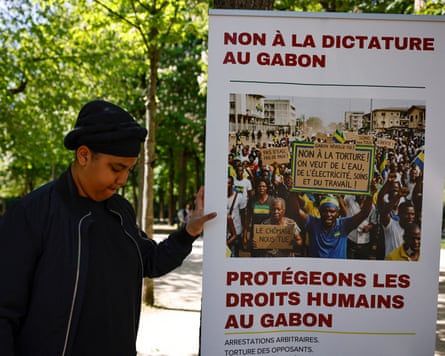
An attendee stands next to a placard reading “no to the dicatorship in Gabon, protect human rights in Gabon” during a demonstration by members of the Gabonese diaspora against the tightening of the regime mear the Gabonese embassy in Paris in April.
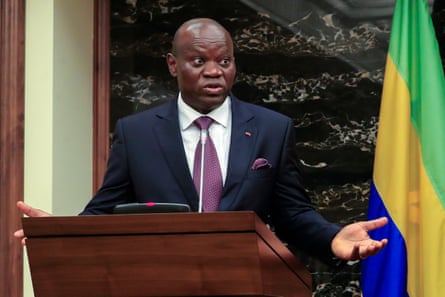
Gabon’s president Brice Oligui Nguema on a visit to Angola on 6 May.

Continue Reading‘Blatant disregard for rights’: concern grows over Gabon’s social media clampdown

Internal displacements caused by violence or conflict at record high in 2025

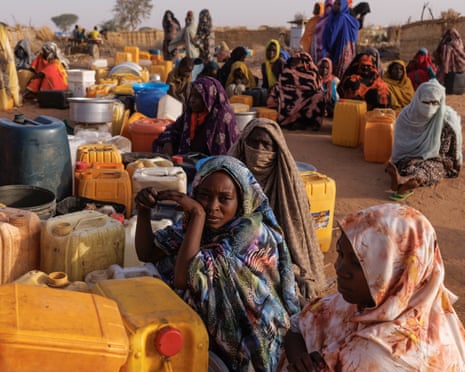
Women and children sit among yellow water containers in an arid refugee settlement

The number of internal displacements triggered by conflict or violence around the world reached a record high in 2025, surpassing the number of disaster-driven internal displacements for the first time.

A report published by the Internal Displacement Monitoring Centre (IDMC) shows that by the end of 2025 there were 32.3m conflict-driven internal displacements. That is 60% higher than those recorded the previous year, and – for the first time since data collection began in 2008 – above displacements driven by natural disasters, which reached 29.9m in 2025.

Jan Egeland, the secretary general of the Norwegian Refugee Council, described the figures as a “sign of a global collapse” in basic protection of civilians.

“Countless families are returning to destroyed homes and disappearing services – or cannot return at all. From DR Congo and Sudan to Iran and Lebanon, we see millions more displaced on top of the previous record numbers driven out of their homes,” he added.

Internal displacements refer to each new instance that a person is forced to flee within the borders of their own country. The same person can be displaced several times.

The IDMC’s Global Report on Internal Displacement also shows that the number of people displaced – during 2025 or earlier but who still remain displaced – remains high.

In total, 82.2 million people were displaced in 2025, the second-highest figure after the historical peak in 2024 of 83.5 million and the first decrease in the number of people forced to flee since data collection began 20 years ago. The total number of internal displacements was 62.2m in 2025.

The decline in the number of people displaced is due to people returning in parts of Sudan, the Democratic Republic of the Congo and Syria, and lack of data availability. However, the report highlights the decline in number “should not be mistaken for progress” as behind the numbers “lie hundreds of thousands of forced returns, destroyed infrastructure and deepening social and environmental pressures” that make permanent solutions for people unrealistic.

More than 83% of the people displaced in 2025 were forced to flee their homes in their countries because of conflict and violence, with the remainder having left because of natural disasters.

Nearly half of all people forced to leave their homes last year because of conflicts were in Sudan, Colombia, Syria, Yemen and Afghanistan. Sudan accounted for the largest number of internally displaced people for the third consecutive year.

The record number of conflict-driven displacements is the result of new international conflicts and intensified existing conflicts that have made it impossible for people to return home.

In 2025, 46% of internal displacements caused by violence were linked to international armed conflicts, nearly double the figure recorded last year.

Iran and the DRC accounted for two-thirds of all conflict-driven internal displacements in 2025.

Tracy Lucas, the director of the IDMC, said: “When you’re talking about the displacements themselves – the movements of people – we have to recognise that in some cases, people are continually displaced. They’re not just displaced once, they could be displaced two or three times … Yet the systems meant to protect them are being dismantled.”

Continue ReadingInternal displacements caused by violence or conflict at record high in 2025

Gaborone gold rush: how Botswana rose to the top of men’s sprinting

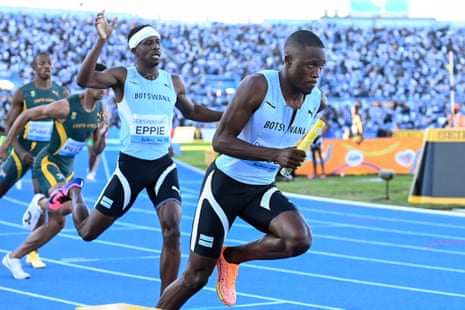
Letsile Tebogo takes the baton in a race on a blue athletics track
Rachel Savage

It was a fairytale ending to the World Athletics Relays in Gaborone. In the final strait, Collen Kebinatshipi surged past South Africa’s Zakithi Nene to win the men’s 4x400m relay for Botswana. The home crowd, a sea of light blue, went wild.

“It means so many things to us,” Letsile Tebogo, 22, the reigning 200m Olympic champion, who ran the second leg, told reporters afterwards. “Not just the team … but for the people that always cheer for us behind the TV. Now they had that experience to see first-hand how much effort, how much pressure, how much we give for them.”

In an interview after the championships, the World Athletics president, Sebastian Coe, said: “I put that atmosphere in the top three that I’ve experienced live in athletics. The first was Cathy Freeman winning in Sydney. The second was Mo Farah hitting the front with a lap or so to go in the 10,000 in London, when the wall of noise was deafening … [This] comfortably sits in the top three for me.”

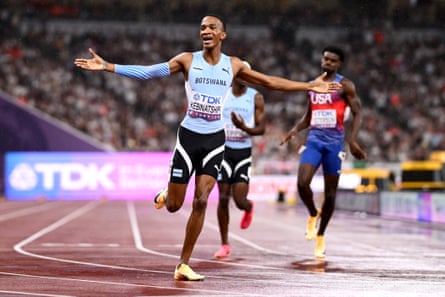
Botswana, a country larger by area than Spain with a population of just 2.5 million, has had a meteoric rise to the top of men’s sprinting. Tebogo’s Olympic gold in Paris in 2024 was the country’s first, and only its fourth medal of any colour. The men’s 4x400m relay team took silver, improving on bronze from three years earlier. Then, at the world championships in Tokyo last year, Kebinatshipi won the 400m while the relay team he anchored also took home gold.

The athletes are superstars in Botswana, their faces plastered on billboards advertising everything from mobile phone contracts to milk. “My life has changed a lot,” Kebinatshipi told a press conference before the relays.

The 22-year-old, who started running at school, said he now allowed half an hour for photos with fans when he went out shopping. “At first I was a bit nervous, because I wasn’t used to it … Nowadays I’m used to it, so it’s cool with me,” he said.

Years-long investment in young athletes is one of the biggest reasons for the southern African country’s recent success, sports officials said. The Botswana Athletics Association’s chief executive, Mabua Mabua, said: “I must thank the school sports programmes that we used to have, because basically all of the athletes that you are seeing, the youthful ones, are coming from that programme.”

He also highlighted the country’s infrastructure. “All of the preparations for the team are done locally. Normally people say ‘no, they should go to Europe, USA, for preparations’. It’s local coaches, a local environment.”

The Botswana National Sports Commission runs programmes for 15 sports to spot and nurture talent. Re Ba Bona Ha, meaning “We See Them Here” in Setswana, is a coaching initiative for children aged five to 13 that was launched for football in 2002, with athletics added in 2008. Up to 300 children attend athletics sessions every year, said Frederick Kebadiretse, the BNSC’s sports development manager.

Then there are twice-yearly holiday camps to identify older students for eight centres of sports excellence, which were founded in 2011. The centres run weekday afternoon and weekend training sessions, with 30 to 40 students picked for athletics annually.

Sports officials warned that without the school sports programme, which was suspended in 2019 due to a dispute between the government and teachers, Botswana’s recent athletics success was at risk. “The pipeline is not there,” said Martin Mokgwathi, who chaired the world relays organising committee. “[Performance] will dip unless something is done very, very quickly.”

Botswana’s female athletes have not yet matched the men’s results. Oratile Nowe, the seventh fastest woman this year over 800m, is the current highest performer.

The officials admitted more needed to be done to support women and girls. “We need to widen the pipeline so we can get more and more young women to join,” Mokgwathi said. “The other thing, of course, is to encourage more and more women to become coaches and technical officials … And we need to protect young women coming into the sport, so that they stay.”

Isaac Makwala is trying to fill the pipelines. Makwala, whom numerous young athletes cite as an inspiration, was the first man to run 400m in under 44 seconds and 200m in under 20 seconds in the same day. The son of farmers from a village in northern Botswana, he started running at school, although he didn’t compete until he was 21.

After retiring in 2024, Makwala founded the Isaac Makwala Athletics Academy, putting about 50 12- to 16-year-olds through sprinting drills five afternoons a week. “I have a daughter here, she drives me to be a coach,” he said. “I want to see how well she will run after. Did she take her talent from me?”

Earlier this year his daughter, Resego Kelly Makwala, became Botswana’s under-18 girls champion in 400m, aged just 14. “I do really like it,” she said. “The times. When I make good times, PBs [personal bests].”

Makwala’s centre relies on motivated parents who can afford the 100 pula (£5.50) registration and 500 pula monthly fees. Tuduetso Gaboutloeloe, a tax collector, is one. “I want to be honest with you, the way the economy is bad, I want to see her going places, maybe getting a scholarship so she can progress very well,” she said. “Because right now, it’s a struggle.”

Her 13-year-old daughter, Leloba, who runs 800m and wants to try 400m too, dreams of Olympic success. “I do imagine myself winning medals,” she said.

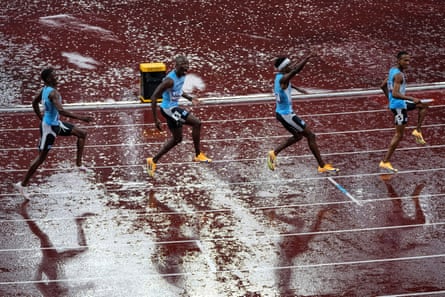
The four team-mates skip along the track in the rain
Collen Kebinatshipi raises his arms either side of him in celebration after crossing the finish line
Resego Kelly Makwala and other young people on an athletics track
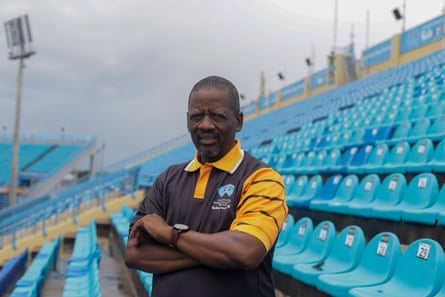
Martin Mokgwathi standing near rows of blue seats in a stadium
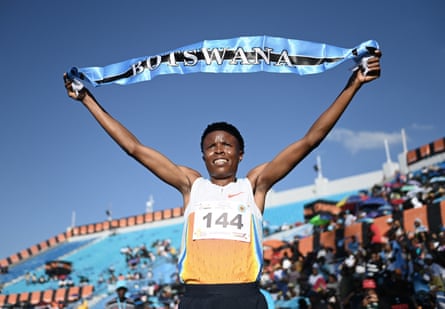
Oratile Nowe raises a Botswana banner above her head
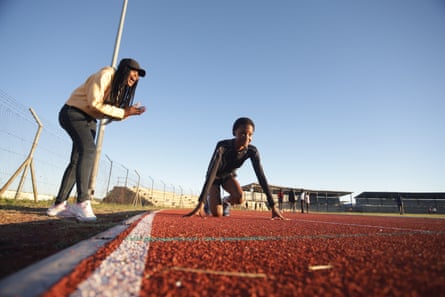
Leloba adopts the starting position on a track as her mother cheers beside her

Continue ReadingGaborone gold rush: how Botswana rose to the top of men’s sprinting

Weather tracker: US and Mexico brace for heatwave as deadly floods hit South Africa

Sun-drenched street in North Phoenix, Arizona

Heat is expected to intensify across western parts of the US and Mexico this week as a ridge of high pressure pushes temperatures well above the seasonal norm. Daytime highs are forecast to reach 10-15C above average in some areas.

The US National Weather Service has issued heat advisories for parts of California and Arizona, with extreme heat warnings in force on Monday and Tuesday in places such as Palm Springs, where temperatures could reach 40-43C (104-110F). More broadly, temperatures are expected to climb into the high 30s celsius before the heat shifts eastwards towards the midwest later this week.

Meanwhile, severe weather is likely to continue across parts of South Africa, with disruptive rain and damaging winds raising the risk of flooding. Rain moved in from the Atlantic across the Western and Northern Cape on Sunday morning, bringing persistent downpours over much of the weekend. Between Monday and Wednesday, more than 200mm of rain could fall across parts of Western Cape, while mountainous regions could record totals approaching 300mm.

The South African Weather Service has issued several warnings, highlighting the potential for flash flooding, mudslides, rockfalls and damage to infrastructure and property.

Heavy rainfall is also expected to coincide with strong, potentially damaging winds. Large areas of southern South Africa, including Western and Eastern Cape, are forecast to experience north-westerly to westerly gusts exceeding 60mph (97km/h) early this week, with even stronger gusts likely over higher ground, particularly across the Cape Fold Mountains.

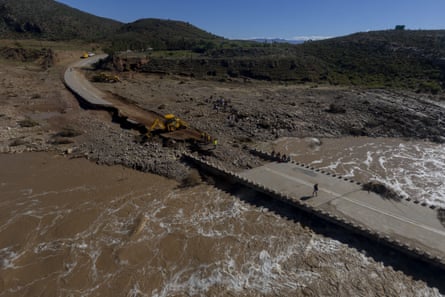
The latest warnings come shortly after heavy rain triggered flooding, road closures and infrastructure damage across the Western and Eastern Cape on 5-7 May. More than 300mm of rain fell in some areas, forcing evacuations in Gamtoos Valley after the Kouga dam exceeded capacity. Power outages and at least 45 road closures left many communities isolated. One person died in Knysna, Western Cape, while more than 2,000 people were evacuated to emergency shelters.

Workers repair a bridge damaged by flooding in Western Cape, South Africa.

Continue ReadingWeather tracker: US and Mexico brace for heatwave as deadly floods hit South Africa

Body of missing US soldier recovered off coast of Morocco

A couple people in camouflage attempt to be dispersing a large crowd from a stadium.

A search team recovered the body of a US soldier who went missing near a cliff during a training exercise in Cap Draa, Morocco, the US Army said on Sunday.

Moroccan searchers found the remains on Saturday in the water within a mile (1.6km) of where the soldier went missing on 2 May, the army said in a statement.

The army identified the solider as 1st Lt Kendrick Lamont Key Jr, a platoon leader in an artillery unit.

A second soldier remains missing and search operations are continuing, according to the army.

The US service members were participating in African Lion, the US Africa Command’s largest joint exercise among US forces, Nato allies and African partner nations.

The largest part of the exercise takes place in Morocco, involving approximately 5,000 personnel from more than 40 countries, according to Africom.

Continue ReadingBody of missing US soldier recovered off coast of Morocco

‘Watching us is like watching a cousin’: the online creators reshaping Africa’s news ecosphere

Amahle-Imvelo Jaxa's video about South African peacekeepers in the Democratic Republic of Congo

Last year Amahle-Imvelo Jaxa posted a TikTok video about South African peacekeepers in the Democratic Republic of the Congo. She explained an argument that had erupted between the South African and Rwandan presidents, then listed roles different South African groups would play in a war with Rwanda: the Sotho strategists, the Xhosa negotiators, the Afrikaner muscle. The video went viral and she racked up 100,000 followers in three days.

This breakout video enabled Jaxa to pivot from being a marketing and restaurant entrepreneur to a “professional yapper and current affairs enthusiast”, part of a group of content creators explaining the news to young South Africans who, like many of their global peers, are eschewing traditional news in favour of social media.

According to the 2025 global Digital News Report by the Reuters Institute, social media users in South Africa, Kenya and Nigeria (the three African countries in the survey) were much more likely to report paying attention to news creators than their equivalents in much of northern Europe and Japan.

In Nigeria, 61% of respondents said they paid attention to news creators, just ahead of Kenya (58%), which in turn was far ahead of Indonesia, which was third, at 44%. The figure for South Africa was 39%.

The three African countries were also in the top four of those surveyed for a metric that aimed to assess the impact of news creators on social media users.

Guardian correspondents spoke to news influencers and analysts in the three countries for their views on changing habits.

South Africa

Jaxa, 32, started posting explainer videos after an argument with her brother, who is 10 years younger than her, about him not voting. She realised “the generation coming after me was very disinterested”.

“That was very concerning for me, because they are the next leaders,” she said.

Jaxa considers herself to be a translator of the news for younger generations, not a replacement: “I don’t exist if there is no traditional media, because … all the content I do is from traditional media.”

Recent topics tackled by Jaxa, who has degrees in philosophy, politics and economics and international relations, include the Iran war, the South African president’s annual state of the nation address and the budget, the last one sponsored by a bank. However, she makes most of her money from brand partnerships on Instagram, where she posts less news content.

News used to be consumed communally in South Africa through a radio or TV, said Sisanda Nkoala, an associate professor at the University of the Western Cape. “The experience of the media being a place where people gather to watch the evening news, that has changed,” she said.

She expressed concern that the shift to online news was widening South Africa’s digital divide. In the 2022 census, 21% of households reported not having internet access, many in rural areas.

Kenya

Valerie Keter got into news creation by chance in 2023 after watching Shaka iLembe, a South African historical drama series on King Shaka of the Zulu Kingdom. As a history buff who grew up watching international historical programmes, she was amazed by the production quality and accuracy and posted a reaction video on TikTok, describing the show as an example of how to preserve African stories for future generations. It blew up, with curious people asking in the comment section about other kingdoms from pre-colonial Africa.

Keter took that as a challenge and started making videos on African history – including explainers and narrations of buried stories – from different countries across the continent and posting them online.

She is part of a class of independent news creators in Kenya who, through the use of social and video platforms, are reaching audiences who are not engaging in traditional media.

Their success is driven by Kenya’s young population and high levels of social media use. A study released on 4 May by the Media Council of Kenya said most Kenyans rely on social media as their source of news.

Today, Keter’s Instagram and TikTok accounts boast dozens of videos and millions of views. Her most popular video, titled “Why Europe Colonised Africa Easily”, has had 3.7m views on Instagram.

The 31-year-old said her main audience is people aged 25 to 34. “When they watch us, it’s like they’re watching their cousin, their sister,” she said. “Also, I’m shooting in my sitting room or my kitchen. It just looks normal, compared to traditional media where everything is so serious.”

Norbert Mburu, the head of culture and media research at Odipo Dev, a Nairobi-based data analytics and research firm that has studied news consumption in Kenya, said social media had democratised participation in the attention economy and news creators were now competing on the same level as legacy media.

“They grew up with mobile phones, they grew up with the internet, they grew up with social media,” he said. “It became very natural that for them.”

News creators are also able to deliver news with more flexibility than established news organisations, Mburu said. “They have to worry a lot less about regulation,” he added.

Nigeria

Bello “Dan Bello” Galadanchi became a self-described news addict after a Boko Haram bombing of a UN building in Abuja in 2011. Uncensored images of the dead kept the then final-year engineering student in faraway Pennsylvania awake and drove him to apply to work with Voice of America (VOA) in Washington DC. “I felt like I could also play a role in the media and help it [the bombing] get attention,” he said. “That was how I started. That really changed my life.”

At VOA and later at BBC Hausa, he accumulated thousands of followers that stayed when he left journalism to further his studies in China. Today, the 38-year-old Beijing-based schoolteacher’s videos in Hausa, Nigeria’s most spoken language, and subtitled in English – its official one – blend satirical analysis of current affairs with advocacy directly targeted at government officials.

Nigerians at home and in the diaspora are obsessed with news and politics, and Galadanchi is one of a crop of super-influencers, with more than 2 million followers on TikTok. In northern Nigeria and parts of Niger, he has a near-fanatical following among young people and unemployed housewives of all ages.

Operating as an informal news network, Galadanchi relies on a staff of two and a team of volunteers that includes professors and other acquaintances from within and outside Nigeria. They source and verify information before he takes it to the public. The team’s exposés have secured the release of people detained indiscriminately, payment of salary backlogs to government employees, and renovation of dilapidated schools.

Galadanchi dismisses accusations of being sponsored by the opposition to talk about ruling party officials and of being used by the northern establishment against southern politicians. “When you look at the work that we’ve been doing, you cannot find any evidence of that,” he said.

The shift to editorialising platforms or those that fuse social commentary with advocacy and comedy is due to a change in consumption habits, said David Adeleke, the chief executive of the Lagos-based media and intelligence firm Communiqué. “Not many people sit in front of TV or radio in urban areas … they have become more familiar and trusting of newer methods of storytelling,” he said.

The viral #EndSars anti-police brutality protests of October 2020 was also a turning point. The mainstream media was seen as cautious in their coverage, perhaps because broadcast regulators have been “significantly more heavy-handed on the media with the last two administrations”, Adeleke said. “These new media platforms were the ones who sort of ‘spoke up’ for the young people … because a lot of people across the country felt alone or almost powerless.”

Amahle-Imvelo Jaxa against an orange background, with her eyes visible and the rest of her in shadow
Valerie Keter on pre-colonial African history
Valerie Keter in a costume with a green feathered neckline
Bello ‘Dan Bello’ Galadanchi's investigative skit about corruption in Kano state
A still from the Nigerian influencer Bello Galadanchi’s profile

Continue Reading‘Watching us is like watching a cousin’: the online creators reshaping Africa’s news ecosphere