Mali’s militant attacks expose limits of Putin’s power in Africa

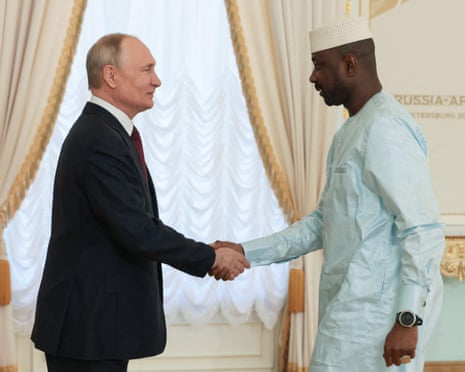
Vladimir Putin shaking hands with Assimi Goïta in a formally dressed room
Pjotr Sauer

When Assimi Goïta, the leader of Mali’s military junta, sat down with the Russian president, Vladimir Putin, in the Kremlin last summer, it symbolised Moscow’s commanding sway over Mali at the expense of the west.

As the two men spoke, roughly 3,500 miles to the south, about 2,000 Russian troops were propping up the regime in the landlocked desert country, as part of Moscow’s broader push for influence across the Sahel region.

But in the last few days, a wave of coordinated, surprise attacks by jihadist militants and a separatist group has exposed the limits of Moscow’s reach and military might in the impoverished west African state.

Over the weekend, rebel fighters launched one of their most effective assaults in years against the Russian-backed authorities. Fighting continued into Monday, with the full picture still unclear.

The rebels have so far achieved at least one major victory. Russia’s Africa Corps, the successor to the Wagner group, said on Monday it had pulled out of Kidal, a strategically important northern town.

“This crisis is definitely affecting the credibility of Russia’s interventions in the region,” said Ibrahim Yahaya Ibrahim of the International Crisis Group thinktank.

Mali’s eastern neighbours, Burkina Faso and Niger, expelled French and American forces following coups in 2022 and 2023 respectively.

They, too, turned to Moscow, with the three countries forming a Russian-backed bloc across the heart of the Sahel.

But it is in Mali that Russia’s presence runs deepest.

“Questions will be raised now over whether the Russians can provide the kind of solution that African nations facing insurgencies are looking for,” Ibrahim said.

The Africa Corps has acknowledged some casualties in the fighting, saying it had evacuated its wounded and heavy equipment.

Military bloggers close to the defence ministry, meanwhile, said a Russian helicopter had been shot down near the city of Gao, killing those on board.

The losses also extend to the highest levels of the Malian government.

The junta confirmed late on Sunday that Sadio Camara, Mali’s defence minister and a key architect of the partnership with Russia, died of wounds sustained in a suicide attack on his residence.

When Mali’s military seized power in 2021, Camara was the driving force behind the country’s quick shift in alliances, Ibrahim said.

The junta expelled France – which had maintained troops in the country since its 2013 intervention against Tuareg and Islamist militants – and turned to Russia as its primary political and military backer.

Since then, Moscow has sought to replicate in Mali a model it has used elsewhere in Africa, offering security support and political backing in return for access to plentiful resources.

The junta initially turned to the Wagner group, the notorious paramilitary network backed by Russia and led by the late Yevgeny Prigozhin. Around 1,000 mercenaries arrived in late 2021 and helped secure a series of battlefield gains.

In November 2023, Wagner-backed Malian forces retook Kidal, a Tuareg stronghold that had been in rebel hands for more than a decade.

But Wagner’s fortunes shifted after Prigozhin’s failed march on Moscow and his murky death in a plane crash two months later, as the Kremlin moved to bring his mercenary empire to heel.

Wagner was wound down, and its fighters in Mali were absorbed into the Africa Corps, a new structure under the direct command of Russia’s defence ministry.

The restructured Russian force has struggled to match Wagner’s military effectiveness and political reach, analysts and former members say, with its most capable forces either fighting in Ukraine or killed there.

The Africa Corps first ran into serious trouble in the summer of 2024, when up to 50 Russian soldiers were ambushed and killed by rebels in Mali – thought to be the deadliest single incident for Russia on the continent.

“Africa Corps is nowhere near as good at its work as its predecessor,” said Marat Gabidullin, a former Wagner commander who remains in contact with members of the new formation.

“Morale is low, commanders are often not qualified, and the soldiers are poorly trained.”

The loss of Kidal now marks a sharp reversal of Russia’s fortunes in Mali.

Ibrahim said: “Losing Kidal after first recapturing it is a major symbolic setback for the Russians.”

But, he added, without Russian backing, the junta’s losses would likely have been far heavier.

“It would have been much more catastrophic for the military regime if the Russians were not stationed in the big cities,” he said.

Moscow has so far struck a cautious tone.

The foreign ministry issued a brief statement condemning the attacks but offered little detail on Russia’s role in the fighting.

But state media and pro-Kremlin Telegram channels were quick to emphasise Moscow’s involvement, crediting Russian forces with helping to hold the rebels at bay.

Kommersant, a well-connected Russian newspaper, wrote: “Largely thanks to the fighters of the Russian armed forces’ Africa Corps stationed in Mali, most of the attacks were repelled.”
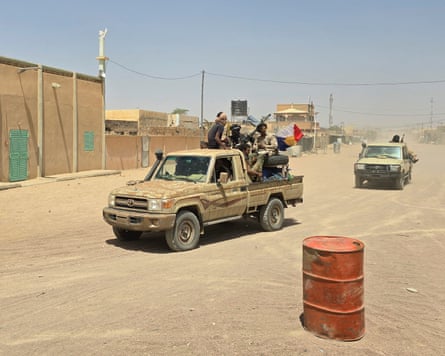
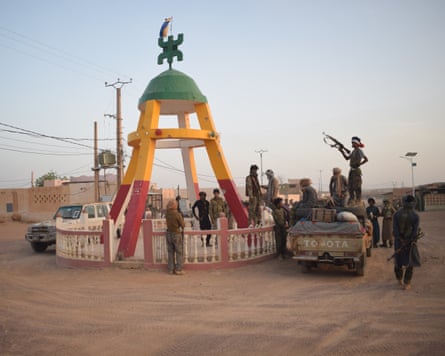
Armed men ride through a desert town on the back of a flatbed truck
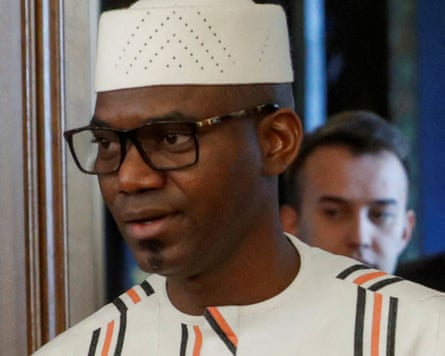
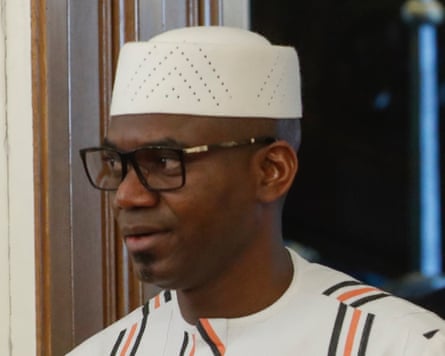
Sadio Camara wearing a kufi cap and glasses
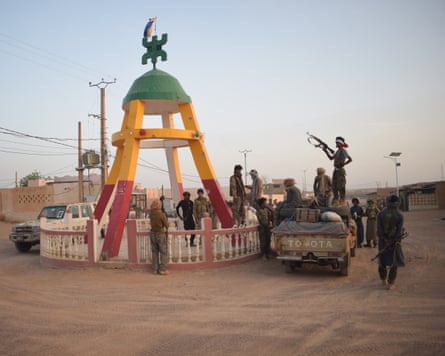
Armed men gather at a structure in the green, red and yellow colours of Mali's flag

Continue ReadingMali’s militant attacks expose limits of Putin’s power in Africa

Mali in turmoil after insurgents seize towns and kill defence minister

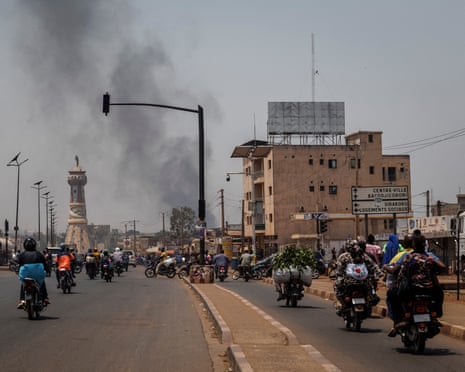
Black smoke rises above Bamako's Africa Tower monument amid ongoing conflict

Mali has been left reeling from sweeping attacks by jihadists and separatist rebels who seized several towns and military bases and killed the defence minister and military intelligence chief.

The weekend assault on the west African state’s security architecture was coordinated by al-Qaida-affiliated Jama’at Nusrat al-Islam wal-Muslimin (JNIM) and the separatist Tuareg-led movement Azawad Liberation Front (FLA) – former foes with distinct agendas.

Mali’s defence minister, Sadio Camara, was killed in an attack on his residence in the garrison town of Kati, the country’s junta-run government said. A spokesperson said a car laden with explosives was driven by a suicide attacker into his residence and that in an ensuing firefight Camara sustained injuries from which he later died in a hospital.

The military intelligence chief Modibo Koné was reportedly also killed and forces from the Kremlin-run Africa Corps paramilitary group backing the military-led government withdrew from a key city.

The attackers used car bombs and armed drones in their assaults on Kati – a junta stronghold just outside the capital, Bamako – as well as the eastern city of Gao and central towns of Mopti and Sévaré.

Heavy gunfire and explosions were heard near Modibo Keita international airport and the main military base at Kati. The airport was temporarily closed.

Videos emerged on social media of jihadists laughing and relaxing at the residence of the governor of Kidal, a town 250 miles (400km) south of the Algerian border. The Guardian has not independently verified the footage.

JNIM and FLA were among the lead actors in the ousting of Ibrahim Boubacar Keïta’s civilian government in 2020. Another coup in May 2021 led to Assimi Goïta, a young captain, becoming head of the junta and the denouncement of an existing peace deal between the government and the rebels.

Goïta, believed to be guarded by a private military outfit from Turkey, which has provided military support for Mali in recent years, is yet to comment publicly on the weekend’s attacks.

Authorities are yet to provide a death toll, but said on Sunday that the assault was over. Speaking on state TV on Sunday night, Gen Oumar Diarra, the chief of general staff, said the army had left Kidal but that Malian forces had “neutralised” more than 200 terrorists across the country and recovered ammunition.

Russia’s Africa Corps – the successor to the mercenary Wagner Group – confirmed it had also left Kidal, long coveted by the separatists as their capital. “In accordance with a joint decision by the leadership of the Republic of Mali, units of the African Corps that were stationed and engaged in combat in the town of Kidal have withdrawn from the area alongside Malian Army personnel,” the statement, posted on Telegram, said.

The FLA spokesperson Mohamed El Maouloud Ramadan claimed the forces left after an agreement was reached for their peaceful exit.

Mali has long battled militants linked to al-Qaida and Islamic State as well as a separatist rebellion in the north. Islamic State – Sahel Province (ISSP), formerly known as Islamic State in the Greater Sahara (IS-GS), was not heard from at the weekend.

Like other countries in the region that fell to juntas, Mali reached a security agreement with the Yevgeny Prigozhin-led Wagner Group after turning away from western allies for help in combating Islamic militants. Camara oversaw the transition to Africa Corps after the death of Prigozhin in August 2023.

The partnership failed to produce results. For months last year, JNIM enforced a blockade of fuel trucks from neighbouring Côte d’Ivoire and Senegal, cutting off crucial supply to the capital until a deal was reached.

Over the weekend, an Mi-8AMTSh helicopter belonging to Africa Corps was reportedly shot down by a surface-to-air missile near Gao, with everyone onboard killed.

According to Ulf Laessing, the Bamako-based head of the Sahel programme at the German thinktank the Konrad Adenauer Foundation, the attack was a serious setback for Moscow’s ambitions in the region. “For Russia the attack has been a disaster,” Laessing told Reuters. “They were unable to prevent the fall of the highly symbolic Tuareg stronghold of Kidal and now need to leave this northern city.”

Meanwhile, there have been reports of an Ivorian aircraft conducting surveillance at the border. Côte d’Ivoire – seen, like Nigeria, as a French puppet by the Malian junta – has been pursuing American collaboration in its north for cross-border operations into Mali and Burkina Faso, another jihadist-hit Sahelian country.

In the Nigerian capital, Abuja, the Economic Community of West African States (Ecowas) issued a statement on Sunday calling for “all states, security forces, regional mechanisms and populations of west Africa to unite and mobilise in a coordinated effort” against insurgency.

Mali split from Ecowas to form the parallel Alliance of Sahel States (AES) in 2025, alongside Burkina Faso and Niger. Ibrahim Traoré, Burkina Faso’s military ruler and AES chair, said the attacks in Mali were “backed by the enemies of the Sahel liberation struggle” but did not give any supporting evidence.

The UN secretary general, António Guterres, expressed deep concern over the violence, emphasising the vulnerability of an estimated 5 million people in Mali who were in need of humanitarian aid.

Sadio Camara
Rebels stand holding guns at a monument
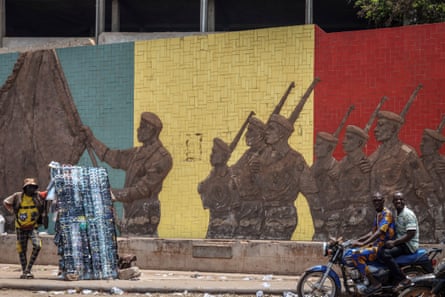
A motorcyclist rides past a monument in support of the Malian army in Bamako

Continue ReadingMali in turmoil after insurgents seize towns and kill defence minister

Mali defence minister killed amid flurry of insurgent attacks

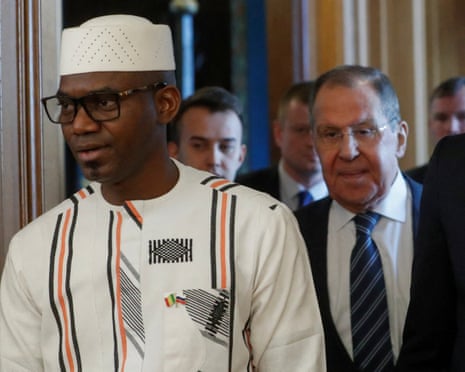
Sadio Camara enters a meeting beside Sergei Lavrov in Moscow

Mali’s defence minister was killed in an attack on his residence, the government said on Sunday, a high-profile fatality during coordinated assaults staged the previous day by insurgents including the West African affiliate of al-Qaida.

A car laden with explosives driven by a suicide attacker drove into Sadio Camara’s residence in the town of Kati, the spokesperson, Issa Ousmane Coulibaly, said in a statement read out on state television. A firefight ensued, and Camara sustained injuries from which he later died in a hospital, Coulibaly said, adding that Mali would observe two days of mourning.

The statement followed media reports earlier in the day that Camara had been killed during the operation in Kati, roughly 9 miles (15km) north of the capital, Bamako, where the army’s main base is located.

The regional al-Qaida affiliate, Jama’at Nusrat al-Islam wal-Muslimin, known as JNIM, cooperated with a Tuareg-dominated rebel group to carry out more than half a dozen simultaneous attacks across the country, according to claims by both groups.

The government has not provided a death toll. Coulibaly expressed condolences for “all civilian and military victims who died” without providing a number.

Analysts and diplomats described Saturday’s insurgent operation as one of the largest coordinated attacks in the country in recent years.

The UN called for an international response to violence and terrorism in West Africa’s Sahel region.

“The secretary general is deeply concerned by reports of attacks in several locations across Mali,” a UN spokesperson posted on X. “He strongly condemns these acts of violence.”

In addition to Kati, Saturday’s strikes hit near Bamako airport and in localities farther north, including Mopti, Sevare and Gao.

The fate of the strategic city of Kidal, a former stronghold of the Azawad Liberation Front, or FLA, the Tuareg-dominated group that partnered with JNIM, was unclear on Sunday.

The FLA said in a statement that Kidal had fallen, and a spokesperson for the group said on X that a deal had been struck to let Russian mercenaries leave a besieged camp outside the city, where Malian armed forces were still entrenched.

But Mali’s army chief of staff, General Oumar Diarra, told the state broadcaster that the military had tactically repositioned forces in Kidal and that operations were continuing in the area.

Ulf Laessing, the head of the Sahel programme at the German-headquartered Konrad Adenauer Foundation, said the attack was a setback for Russia, which backed the military-led government after it kicked out French, US and other western forces.

“For Russia the attack has been a disaster,” Laessing said. “They were unable to prevent the fall of the highly symbolic Tuareg stronghold of Kidal and now need to leave this northern city.”

The Russian state-run broadcaster Vesti reported on Sunday that Russia’s Africa Corps was repelling a large-scale militant attack on Mali’s government.

According to Vesti, Russian personnel were responding along with units of Mali’s presidential guard and armed forces, preventing the presidential palace from being seized.

Vesti said some members of the Africa Corps were wounded, without providing further details.

Saturday’s attacks are the latest sign that Mali’s government has not delivered the greater security it promised. In September 2024, JNIM attacked a paramilitary police training school near Bamako’s airport, killing about 70 people. More recently, it carried out a fuel blockade that has starved the capital’s residents and businesses of power and supplies.

The government has recently pursued closer ties with Washington, which has sought to rebuild cooperation on security and explore mining opportunities.

Mali’s foreign minister told Reuters last week that neighbouring states and foreign powers were backing terrorist groups, but declined to name the countries.

Continue ReadingMali defence minister killed amid flurry of insurgent attacks

‘Astonishing’ discovery could help save children from deadly disfiguring condition

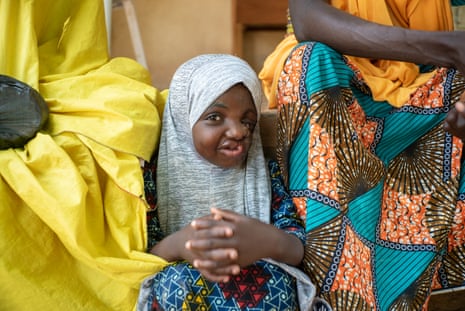
A smiling girl with facial scarring
theguardian.org

The “astonishing” discovery of a new bacteria could open the door to better ways to prevent, detect and treat a fatal and disfiguring childhood disease, researchers hope.

Noma, which is fatal in 90% of cases without treatment, begins as a sore on the gums but goes on to destroy the tissues of the mouth and face.

It mainly affects young, poor and malnourished children, and has been called the “face of poverty”. Those that survive are left with lifelong scarring and disfigurement. Data on noma is patchy, but expert estimates put case numbers at tens of thousands every year. Most cases are reported in the Sahel region of Africa, but it also occurs in other parts of the world.

While it can be successfully treated with broad spectrum antibiotics, pointing to a bacterial culprit, the precise underlying cause of noma, classified as a neglected tropical disease, has never been established.

Research led by the Liverpool School of Tropical Medicine set out to study the community of bacteria living in noma patients’ mouths, using samples taken from 19 children in Nigeria.

Modern genetic analysis techniques revealed an apparently disturbed community of microbes, with lower levels of normal, healthy bacteria, but other strains greatly increased. Deeper analysis uncovered a previously undescribed species of Treponema bacteria in most of the noma patient samples.

When Angus O’Ferrall, the PhD student who had put the data together and found the species in the samples, presented the results, Prof Adam Roberts, a senior author on the study, said it was “a great reveal”. “I was astonished,” he said.

The scientists went on to reanalyse older samples from other noma patients, and found the Treponema bacteria – currently called Treponema A – was also present in those.

“We don’t know causality,” stressed Roberts. “We don’t know if it can colonise a noma wound, because of the architecture and the environment, or if it causes the noma wound.”

The team is now trying to answer that question with a larger study that will use samples from more noma patients and healthy individuals in the same communities, across multiple countries.

Once noma progresses to its necrotising stage, there are only two paths for the patient, according to Roberts. Either they are treated swiftly with antibiotics “and you usually get a good recovery, but massive disfiguring – and with that comes lifelong stigma and social exclusion – or death. We want to stop it reaching that point.”

In the future, a test for children with gingivitis that reveals the presence of Treponema A could save them from either fate, Roberts hopes.

“At the moment, the only thing that we have is a clinical diagnosis based on symptoms. And that can be a foul smell [or] holes in the skin and the tissues,” he said. “But if we know that actually Treponema A, for example, is always or 99% associated with the development of noma at the gingivitis stage then we could detect and treat prophylactically with antibiotics to stop it progressing.”

The current treatment for noma, using broad-spectrum antibiotics, risked increasing antimicrobial resistance, Roberts said. A targeted treatment aimed at a specific bacteria could reduce that threat.

And the drop in healthy bacteria seen in noma patients raised the prospect of “a potential preventive intervention” with probiotics, he added.

The study was published in Plos Neglected Tropical Diseases, and also included researchers from the University of Liverpool, Médecins Sans Frontières and the Noma children’s hospital in Sokoto, Nigeria.

Dr Michael Head, senior research fellow in global health at the University of Southampton, who was not involved in the study, said the findings were a useful first step to understanding a “currently mysterious condition”. “A different version of this Treponema bacteria causes syphilis, which is known for being a sexually transmitted infection, but can and does also cause wounds and ulcers within the mouth.”

Prof Philippe Guérin, director of the Infectious Diseases Data Observatory, University of Oxford, agreed the study was “a valuable starting point and should help stimulate greater interest from both the research community and funders”.

Continue Reading‘Astonishing’ discovery could help save children from deadly disfiguring condition

US millionaire big-game hunter dies after being crushed by elephants

elephants graze

An American millionaire big-game hunter has died after being crushed by a group of elephants during a hunting expedition in Gabon.

Ernie Dosio, a 75-year-old vineyard owner, was hunting yellow-backed duiker, an antelope species, in the central African country of Gabon when the incident occurred last Friday. While in the Lope-Okanda rainforest, he and his guide unexpectedly came across five female elephants accompanied by a calf.

Originally from Lodi, California, Dosio had built an extensive collection of hunting trophies over the years, including animals such as elephants and lions. He was reportedly a familiar name within the Sacramento Safari Club.

According to the Daily Mail, safari operator Collect Africa confirmed the death of its client. The company also reported that the professional hunter guiding Dosio sustained serious injuries during the encounter.

Reflecting on Dosio’s life, a retired hunter who knew him shared with the UK outlet: “Ernie has been hunting since he could hold a rifle and has many trophies from Africa and the US. Although many disagree with big-game hunting, all Ernie’s hunts were strictly licensed and above board and were registered as conservation in culling animal numbers.”

The same source, based in Cape Town, described the incident as the elephants being “surprised” by Dosio and his guide’s presence.

Dosio was the owner of Pacific AgriLands Inc, a company managing 12,000 acres of vineyard land in Modesto, as well as offering services and equipment financing to wine producers. Officials from the US embassy in Gabon are now coordinating the return of his remains to California, the Mail reported.

Gabon’s forests are known to shelter approximately 95,000 forest elephants, most of the species’ global population, which are considered highly endangered.

Every year, clients of the trophy-hunting industry claim the lives of tens of thousands of wild animals across the world. Legal hunting tours in Africa are popular with some wealthy Americans, including Donald Trump Jr, who was pictured holding a severed elephant’s tail more than a decade ago.

International trophy hunting is a multimillion-dollar industry. In South Africa, estimates for the industry’s worth range from $100m in 2005, to $68m in 2012, and $120m in 2015, according to the EMS Foundation.

During his first presidential term, Donald Trump created a controversial wildlife advisory board to help rewrite federal rules for importing the heads and hides of African elephants, lions and rhinoceroses. The board was disbanded in 2020 after lawsuits alleging it was an illegal, biased panel stacked with trophy hunters rather than conservationists, who worked to promote the economic benefits of big game hunting.

Last year, another American game hunter was killed by a buffalo he was stalking during a hunting expedition in South Africa.

Continue ReadingUS millionaire big-game hunter dies after being crushed by elephants