Calls for humanitarian corridor through strait of Hormuz as Iran war hits vital aid

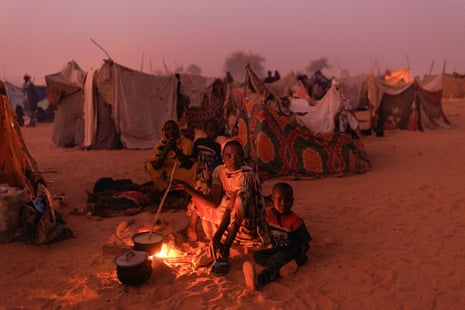
A woman cooks on a small fire outside sitting on the ground. A child sits next to her. Makeshift tents can be seen behind them
theguardian.org

The volatility of global oil prices caused by the US and Israel’s war on Iran is taking a toll on the most vulnerable people, by slowing or blocking food and medical aid from reaching them.

Now aid organisations are calling for a “humanitarian corridor” to be opened through the strait of Hormuz amid rocketing transportation costs.

Bob Kitchen, vice president for emergencies at the International Rescue Committee (IRC) called for “serious and immediate conversations about humanitarian corridors through the strait of Hormuz so, at the very least, we can get supplies that are currently stuck in humanitarian hubs through the strait to resupply.”

Vital medicines are not making it out of key hubs. Shipping disruptions prevented the IRC accessing $130,000 (£96,000) of supplies stuck in Dubai that are needed by 20,000 people in Sudan. In Nigeria and Ethiopia, government oil rations meant the emergency relief body was having to limit generator use in its health clinics. “In certain parts of hospitals, we’ll have to close off the electricity to keep more important things running [if this continues],” said Kitchen.

He said aid agencies were burning through budgets rapidly. “It is more expensive to buy fuel to run our operations, moving commodities, moving personnel around many of the countries in sub-Saharan Africa,” he said.

Cecile Terraz, director at the International Federation of Red Cross and Red Crescent Societies, said: “The reality here is that it’s 100% sure that the increase of oil price is affecting the lives of people and also our operations.”

Since the conflict began in February, oil prices have fluctuated, peaking at almost $120 a barrel, up from $60 at the start of the year, as the US and Iran took turns at closing and blockading the strait of Hormuz shipping channel. Limiting the number of cargo ships passing through the 5km-wide passage has had an extraordinary global impact, reducing the global supply of oil, food, fertiliser and medicine, and driven up the price of what is available. The current cost of oil, a primary source of fuel, is nearly $111 a barrel.

Big aid agencies, still reeling from US and European funding cuts, have been badly caught out, because many export humanitarian products including food and medicines from hubs in India and Dubai to communities in need, many of which are in Africa.

Estimates by Save the Children found every $5 increase per barrel of oil cost the charity an additional $340,000 a month in shipping costs, fuel, food and medical supplies over what was budgeted for at the start of the year. That was equivalent to a month of aid for nearly 40,000 children, said the agency’s director of global supply, Willem Zuidema. If oil prices remained at about $100 for the rest of 2026, it would cost the charity an extra $27m this year, he said.

The disruption meant 45 million more people could go hungry, according to the World Food Programme (WFP), in addition to the 318 million people already considered food insecure before February’s attacks.

“We are being squeezed from both ends. While world leaders are cutting aid budgets, conflict is driving up the cost of every shipment, every sachet of food, every medical kit we send,” said Zuidema.

The US cut its foreign assistance by 57% in 2025, while UK aid last year was at its lowest since 2008. Norway, Germany and France have all slashed their aid budgets.

In Yemen, where, after more than a decade of war, nearly half the population is in need of aid, the cost of shipping in goods has risen by up to 20%, because of fuel costs, according to Save the Children’s estimates. Food prices there have risen by 30%.

In Somalia, Robyn Savage, Care’s humanitarian director, said the cost of importing key medications for acute malnutrition in children had tripled since the conflict began. “This means there is less medication available for those children, and that will result in fewer children being able to be treated,” she said.

The country, which is experiencing severe drought, has also seen the prices of basic foods rise by 20% as fuel prices drive up transportation costs, according to the World Food Programme (WFP).

In Myanmar, a basket of goods was up by 19%. And the cost of getting food into landlocked Afghanistan had tripled, said John Aylieff, the WFP’s Afghanistan country director.

The WFP’s supply of fortified biscuits was having to be transported by road through seven countries from Dubai to Afghanistan to avoid the usual route via the strait of Hormuz, said Aylieff, taking three weeks longer than usual. “Afghan children today are going hungry as a result,” Aylieff said, adding that many could die.

Another spokesperson at the WFP, the world’s largest humanitarian organisation, told the Guardian that the organisation had estimated the oil price increase meant it would not be able to reach approximately 1.5 million people around the world in the coming months. The UN agency is working to re-route about 93,000 tonnes of food, such as fortified biscuits and nutrition supplements, destined for communities with urgent needs, including refugees from the war in Sudan – the world’s largest humanitarian emergency – a significant cost and delay. It is not only ships routed through the strait of Hormuz being held up, they explained, but all shipping throughout the region was feeling the impact of the resulting widespread congestion at sea.

For example, supplies from manufacturing hubs in India typically sail from a port near Mumbai to Oman to Jeddah through the strait of Bab el-Mandeb and on to Port Sudan. Now due to risk and congestion, they sail around the Cape of Good Hope through the Mediterranean to the Suez canal and then on to Jeddah, adding 9,000km and several weeks on the journey.

In Bangladesh, the world’s largest development NGO, Brac, said its staff were spending five hours a week queueing for rationed fuel, reducing the amount of time they could spend working in refugee communities.

Even if a ceasefire held, Savage warned of ramifications for months to come. “We haven’t even seen the tip of the damage that’s already been incurred.”

In Sudan, Pakistan, Cambodia, Bangladesh and Ethiopia, where planting season has started, shortages of fertiliser and fuel will badly affect farmers’ ability to grow crops, driving up food insecurity, said Nick Jones-Bannister, of Mercy Corps. Up to 45% of the world’s seeds and fertilisers depend on access through the strait of Hormuz, according to the UN. “That will have a knock-on impact on civil conflict and on migration,” Jones-Bannister said.
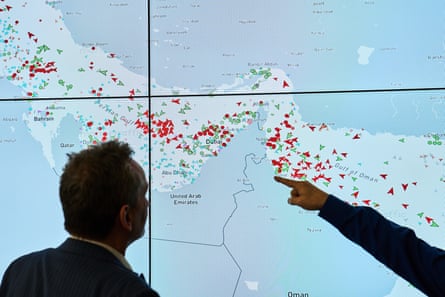
A man looks at a wall map of the strait of Hormuz with dots representing ships, while another points at it
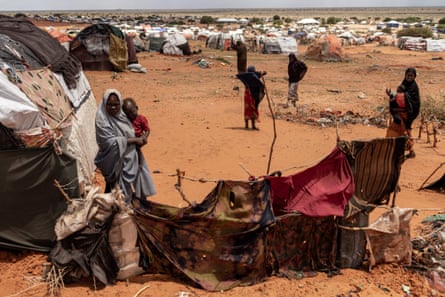
A woman holds a child next to a tent in a camp for displaced people in Somalia.
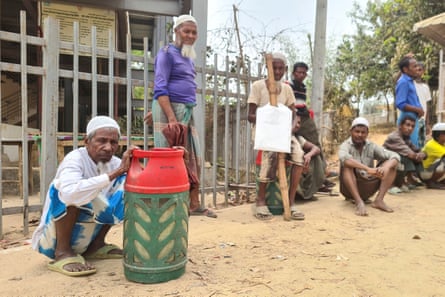
A man crouches beside a gas canister on a dusty street. Several other people stand around nearby
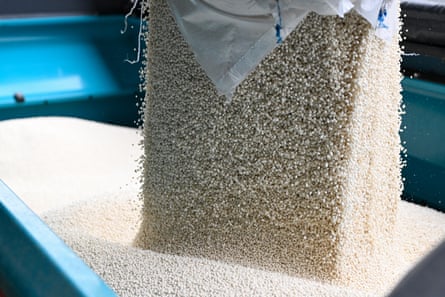
Ammonium nitrate fertiliser is poured into a spreader.

Continue ReadingCalls for humanitarian corridor through strait of Hormuz as Iran war hits vital aid

Russia claims its Africa Corps group prevented coup in Mali after rebels seize towns

Al-Qaida-linked rebels patrol Kidal in northern Mali

Russia’s defence ministry has claimed its Africa Corps – the successor to the former Wagner mercenary group – had prevented a coup in Mali over the weekend, avoiding mass civilian casualties and inflicting “irreplaceable losses” on rebel insurgents.

It said in a statement that its troops in the desert town of Kidal near the Algerian border had fought for more than 24 hours while completely surrounded and vastly outnumbered. It also alleged without providing evidence, that the militants had been trained by European mercenary instructors including Ukrainians. The casualty toll was not specified.

Local reports on Monday had suggested that contrary to Russia’s claims, the Africa Corps troops negotiated their exit, with Algeria as a mediator.

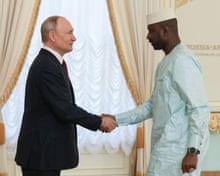
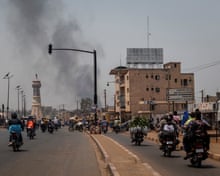
Rebel forces in Mali over the weekend drove the Africa Corps from Kidal, launched an attack near the capital, Bamako, and killed defence minister Sadio Camara – a key Moscow ally – in an apparent suicide bombing.

Kremlin spokesperson Dmitry Peskov separately told reporters in Moscow on Tuesday that restoring peace and stability in Mali was a priority.

The fall of Kidal – a city Russian forces first helped the junta recapture in 2023 – and handover of territory to the rebel alliance has been seen as proof of the limits of Moscow’s military influence in west Africa.

French state radio RFI quoted one Malian official as anonymously saying that Kidal’s governor had warned Africa Corps of the attack three days before it happened and that their exit was pre-negotiated. “The Russians betrayed us in Kidal,” the official said.

Mali has been gripped by violence on multiple fronts since 2012 after a rebellion triggered by Tuareg rebels. The security crisis hit a new peak on Saturday after the separatists and al-Qaida-linked jihadists joined forces to launch coordinated attacks, dealing a major blow to the country’s military junta and its Russian backers.

In recent years, Russia has made inroads in the Sahel, the semi-desert belt stretching across countries including Mali, Burkina Faso and Niger. All three have experienced military coups in which French and UN forces were expelled and replaced by Russian support, as juntas sought to shore up their rule and confront long-running Islamist insurgencies and separatist rebellions.

About 2,000 Russian troops are deployed in landlocked Mali under the Africa Corps banner, the successor to the Wagner group across much of the continent. Military bloggers close to the defence ministry previously said that one Russian helicopter had been shot down near the city of Gao, killing those on board.

Footage posted on social media appeared to show Russian soldiers engaged in fighting with insurgents, with one clip showing rebels seizing Russian military hardware. Residents of neighbourhoods within and on the outskirts of Bamako also reported seeing al-Qaida affiliate Jama’at Nusrat al-Islam wal-Muslimin (JNIM) terrorists freely moving around in the last few days.

Analysts like Ulf Laessing, Bamako-based head of the Sahel programme at the German thinktank Konrad-Adenauer-Stiftung say the Russians could change tactics in the short-term at least and move southwards. “I think the Russians will focus on defending the regime and leave the north to rebels,” he told the Guardian.

Peskov told reporters Moscow had no information on the whereabouts of Assimi Goïta, the military ruler who deposed Mali’s civilian government in a 2020 coup and assumed office within a year, but had not been seen publicly since the unrest began. The Malian presidency posted a photo of him in a meeting with Russian ambassador Igor Gromyko, on X on Tuesday afternoon, in a meeting purported to have happened on the same day.

That however did not diminish speculation about Goita’s future as military ruler and reports of factions within the junta. “Goita has lost his footing … he no longer has political legitimacy over the junta,” one former Malian diplomat told the Guardian under condition of anonymity.

Continue ReadingRussia claims its Africa Corps group prevented coup in Mali after rebels seize towns

Fears of resurgence in Somali piracy after three vessels hijacked in a week

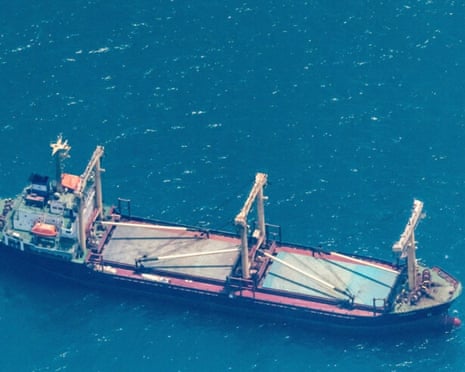
The motor vessel Sward on the sea.

Three vessels have been hijacked off the coast of Somalia in the past week, raising fears of a resurgence in piracy around the Horn of Africa, and adding to the woes of the global shipping industry.

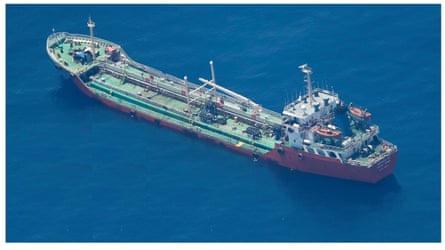
The merchant vessel Sward was taken over on 26 April, a day after a dhow was seized. These followed the 21 April hijacking of Honour 25, a motor tanker carrying 18,000 barrels of oil, according to the Maritime Security Centre Indian Ocean (MSCIO), the tracking service of the EU’s naval force.

“All incidents remain ongoing …,” the MSCIO said in a statement on Monday. “Vessels operating in the area are strongly advised to maintain heightened vigilance … particularly within 150NM [nautical miles] of the Somali coast between Mogadishu and Hafun where feasible.”

Piracy around Somalia jumped in the late 2000s, peaking in 2011 with 212 attacks, according to EU naval force data. Pirates became more audacious, raiding ships as far as 2,270 miles off the Somali coast in the Indian Ocean.

An international naval coalition then stemmed the tide of attacks, cutting them to just a handful each year from 2014. However, incidents began to rise again in 2023.

Global shipping is already reeling from the near-total closure of the strait of Hormuz by Iran and attacks by the Iranian-backed Yemeni Houthi rebels around the narrow Bab el Mandeb strait. Ships have to sail through the straits to exit the Red Sea, one of the world’s busiest shipping routes, with many then heading around the Horn of Africa.

Sward is a cement carrier that left the port of Suez in Egypt on 13 April. It was en route to Mombasa, Kenya, when it was captured by pirates about 11km (6 nautical miles) from the Somali port town of Garacad. The ship had 17 crew members, 15 from Syria and two from India, according to three security officials from the autonomous Somali region of Puntland.

After the hijacking shortly after 8pm on Sunday, the pirates steered the ship towards the coast and anchored it in a remote area near Garacad. Six armed men and an unarmed interpreter fluent in English and Arabic then boarded the ship.

“He’s not only speaking with the crew but also dealing with the owner of the ship,” one of the security officials said. A second official simply put it: “The interpreter is in charge.”

As of Tuesday morning, four more armed men had boarded Sward, bringing the total number of pirates on board to 20, according to the officials.

Jethro Norman, a senior researcher with the Danish Institute for International Studies, said pirates had taken advantage of international navies diverting resources towards the Red Sea to combat the Houthi attacks, and Puntland’s Emirati-backed security forces being stretched.

Norman said: “Pirate networks are testing the waters again and they are better equipped than the last generation. GPS, satellite communications and hijacked dhow motherships let them operate hundreds of miles offshore.”

A third Puntland security official said that a shipment of khat, a narcotic stimulant widely used in the Horn of Africa, was taken out in a small boat to the pirates on the cement carrier on Tuesday morning. It had been driven about 150 miles from the inland city of Galkayo on Monday, suggesting that the pirates have a network on land and are potentially preparing for a long siege out at sea.

The motor tanker Honour 25.

Continue ReadingFears of resurgence in Somali piracy after three vessels hijacked in a week

Taking power in Mali might be a stretch but insurgents can force hand of weakened regime

Smoke rises above buildings in Bamako during rebel and jihadist attacks on Mali

When al-Qaida-affiliated Islamic militants launched a series of attacks on military bases and raids into major towns in Mali and neighbouring Burkina Faso last summer, observers suggested they had been inspired by their counterparts in Syria, who had overthrown the regime of Bashar al-Assad and taken power six months or so earlier.

Despite the tactical successes that earned them the fearful title of the “Ghost Army”, seizing swathes of territory and denying cities and the military of fuel and other essentials, the chances of Jama’at Nusrat ul-Islam wa al-Muslimin (JNIM) definitively defeating Mali’s military regime and the thousand or so Russian mercenaries hired to defend it looked poor.

This week few think the regime of Assimi Goïta, a soldier who seized power in Mali in 2021, will survive very long – even if most analysts still believe it is more likely the Islamic militants and their separatist partners will seek to force concessions from authorities in the chaotic, poor and violent African country rather than seek outright control.

Recent days have seen a paroxysm of violence in Mali that is shocking even for the Sahel, which stretches below the Sahara across Africa from the Atlantic to the Indian Ocean. The region has been scarred in recent years by successive coups d’état, extremism, humanitarian crises and wars. Major UN, US and French counterinsurgency and peacekeeping missions between 2012 and 2022 all failed. Few external powers have been keen to get involved again.

The joint offensive launched last weekend by JNIM and its allies in Mali’s Tuareg minority community was carefully planned and coordinated. It targeted government forces and their Russian auxiliaries with ambushes, car bombs, drones and more conventional weapons, inflicting significant casualties. One was Mali’s defence minister, Sadio Camara, killed in a suicide attack on his residence in the garrison town of Kati. Another was the head of military intelligence.

Other attacks hit Bamako’s international airport, while JNIM fighters and Tuareg separatists seized control of the key northern town of Kidal after soldiers fled and a force of Russian mercenaries surrendered. The defeat reversed a key symbolic victory won by the junta in Mali three years ago.

Jean-Hervé Jezequel, Sahel project director for International Crisis Group, described “a major escalation in the conflict, a new stage reached by armed groups in the strategy that has driven them in recent years to attack Mali’s main urban centres”.

There are deeper underlying reasons for the new surge of violence. The Sahel offers a perfect storm of factors that lead to violent extremism: grinding poverty, instability, sectarian tensions and a history of decades of conflict that has left huge numbers of weapons.

Last year just under 70% of deaths from terrorism occurred in only five countries, of which three were in the Sahel.

A further accelerant is the brutal counterinsurgency tactics systematically employed by armed forces and Russian mercenaries across the region, and, above all, the failure of governments to provide basic services and security.

In country after country, militants have exploited this by offering protection and some basic assistance, as well as coercing communities into accepting their authority and strict Islamic rules. Expansion is essential to their campaign. Controlling populations means young men can be recruited and mosques can be used to bolster influence and authority. Control of roads and rivers means traffic can be taxed and routes used for lucrative smuggling operations.

Ulf Laessing, who runs the Sahel programme of Germany’s Konrad Adenauer Foundation from Bamako, said the main focus for JNIM was to carve out an enclave within Mali which would allow it to build up its “own state in some kind of autonomy”, as al-Sharaa and HTS did in Syria before launching their lightning offensive to overthrow the al-Assad regime.

The tactical alliance with the Tuareg separatists is in line with a strategy pioneered by al-Qaida, to which JNIM may owe a tenuous loyalty, which encourages militants to build relationships and connections with communities. It is unlikely the alliance would survive victory, however, according to analysts.

Laessing said JNIM and other Islamic militant groups were “testing the bulwarks of regimes everywhere”.

“I don’t think Bamako will fall … The JNIM can’t control large cities but they can force governments to their knees and negotiate with them and force them to adopt more of their ideology,” he said.

“JNIM plays a long-term game. They can simply wait until the state authority erodes further.”


Continue ReadingTaking power in Mali might be a stretch but insurgents can force hand of weakened regime

Gunmen kill at least 29 at football pitch in north-east Nigeria, governor says

An orphanage in Lokoja, Nigeria, that was raided by gunmen

Gunmen have killed at least 29 people in north-east Nigeria, a state governor said on Monday, with local people saying the attackers targeted young people gathered at a football pitch, the latest bout of deadly unrest in Africa’s most populous nation.

The attack on Sunday occurred in Adamawa state, which borders Cameroon, and is a hotspot for violence by jihadists and criminal gangs. Communal violence over conflict for land is also rife in the state.

The latest attack comes as Nigeria’s security crisis is increasingly under scrutiny both abroad and at home as general elections are less than a year away.

Ahmadu Umaru Fintiri, the governor of Adamawa state, visited the scene of Sunday’s attack and “confirmed that no fewer than 29 people were killed in a deadly attack on Guyaku community in Gombi local government area”, his spokesperson said in a post on social media.

Local people also gave a similar toll.

Philip Agabus, a local resident, told Agence France-Presse: “Our people converged at a football pitch in Guyaku community … [and] were attacked by insurgents who entered with guns and began shooting randomly.”

The dead were “youths, including some ladies that were watching football”, another resident, Joshua Usman, told AFP. “They also burned places of worship, houses and motorcycles.”

The state governor’s office wrote: “The attackers operated for several hours, killing dozens of residents, burning places of worship, and destroying property including motorcycles.” It cited a local community leader, Aggrey Ali.

Local television showed footage of a burnt church and several charred motorcycles.

The governor blamed the Boko Haram militants who are active in the north-east of Nigeria.

But a rival group, the Islamic State’s West Africa Province (ISWAP), claimed responsibility for the attack saying it “killed at least 25 … Christians” and “torched a church and nearly 100 motorcycles”, in a statement reported by the SITE monitoring group.

Fintiri condemned the attack, saying “it will not go unpunished” while he vowed “intensifying security operations immediately to restore peace”.

Since 2009, the jihadist insurgency in Nigeria, led primarily by Boko Haram and the ISWAP, has left tens of thousands of people dead and millions displaced in the north-east of the country, according to the United Nations.

The jihadist conflict has spread to neighbouring Niger, Chad, and Cameroon.

Nigeria is now looking to the US for technical and training support for its troops fighting the jihadists after a resurgence of violence strained relationships between the two countries.

A separate attack occurred on Sunday in another district more than 100km away, which a local community blamed on farmland disputes in several villages in the Lamurde area.

Bulus Daniel, a local government council chair for the Lamurde area, told AFP: “Lives were lost; properties were also lost.”

Meanwhile, Nigerian security forces rescued 15 pupils after gunmen abducted 23 children and the wife of a school proprietor during an attack at the weekend on an unregistered orphanage and school in central Nigeria’s Kogi state, the state government said.

Kingsley Femi Fanwo, the Kogi state commissioner for information, confirmed that 15 pupils have been rescued and that efforts were ongoing to secure the release of the remaining victims.

School kidnapping is thriving in most parts of Nigeria because security is weak and perpetrators demand ransom before they release their victims.

Mass kidnappings, despite repeated government pledges to prevent such incidents, continue to disrupt education, commerce and travel, leaving frustrated residents questioning the authorities’ effectiveness in addressing the threat.

Additional reporting by Reuters

Continue ReadingGunmen kill at least 29 at football pitch in north-east Nigeria, governor says

German tourist dies after being bitten at snake show on family holiday in Egypt

Two cobras

A German tourist has died after a snake crawled into his trousers and bit him as he watched a show in Egypt on a family holiday, police in Germany have said.

The 57-year-old man was watching the snake-charming show at a hotel in Hurghada, a popular beach holiday destination on the Red Sea, in early April.

The two snakes involved, thought to be cobras, were draped over the necks of audience members, police in southern Bavaria state said.

“The ‘snake charmer’ then let one of the snakes crawl into the trousers” of the German man and it bit him in the leg, they said in a statement.

The victim showed “clear signs of poisoning” and had to be resuscitated before being taken to hospital, where he later died, they said.

The man – who was not named in the statement – came from the Unterallgäu district of Bavaria and was on holiday with two relatives.

German police and prosecutors are investigating his death and are awaiting the results of a toxicology test.

When contacted by Agence France-Press, Egyptian authorities said they were not aware of the incident.

Continue ReadingGerman tourist dies after being bitten at snake show on family holiday in Egypt