British woman died in Ghana trying to recoup money from scammers, inquest told

Janet Fordham

A British woman who was scammed of up to £1m in a string of so-called romance frauds died in a road crash after travelling to west Africa to try to recoup some of her lost fortune, an inquest in Devon has heard.

Janet Fordham was cheated of her life savings and her home over a period of five years by fraudsters apparently based in the UK, Germany, the US and Ghana, the inquest in Exeter was told.

The retired housekeeper, 69, travelled to Ghana after a man there told her he could help her get some of her money back but she was killed in a car crash as he drove.

Members of Fordham’s family and Devon and Cornwall police said they had tried to stop her sending money to scammers but she had been judged to be of sound mind and could not be forced to desist.

Fordham’s daughter-in-law Melanie Fordham said she had begun using online dating websites in 2017 and met a man claiming to be a British army sergeant major working in Syria who needed her help to get gold bars to the UK.

“He was retiring soon to return to the UK,” Melanie Fordham said. “She said they were in love and they were going to buy a house together. I remember saying to her that it all seemed a little unbelievable, and the next thing he would be asking for money. I told her categorically not to send him any.” But she is believed to have handed over about £150,000.

Later she was defrauded by a man claiming to be a diplomat. “I think she realised that she had been scammed, but initially struggled to accept it,” Melanie Fordham said. “We’re not clear how Janet transitioned from one fraud to the next. She transferred money by several means, including bank transfers, wire transfers at the post office, and potentially a travel agent.”

The inquest heard Fordham was contacted by a man in Ghana known as Kofi. He claimed he was a doctor and had found out she was being scammed when he came across her details while working part-time in a phone shop. Kofi told her he would help her get her money back and she flew to Accra in October 2022.

Melanie Fordham said: “I spoke to her doctor, sought legal advice, but because she was of sound mind, albeit brainwashed, she was deemed to have capacity and there was nothing we could do. She travelled with the intention and in the belief that she could retrieve some or all of that money.”

The relationship with the man appeared to develop into a romance and Fordham agreed to marry him, the inquest heard.

On Valentine’s Day in 2023 he was driving her to meet a family member to discuss the marriage when the car swerved and flipped on to its roof. Fordham was not wearing a seatbelt and was fatally injured.

Devon and Cornwall police concluded no third party was involved in the crash. The man admitted a driving offence.

DS Ben Smith told the inquest Fordham had been the victim of a “sustained fraud” between 2017 and 2022 and had sent an estimated £800,000-£1m to fraudsters. He said she had sold her home and land and had been living in a caravan in Devon.

He said: “Police throughout these investigations have endeavoured to do everything they can to persuade Janet not to have any contact with the criminals and not to hand over money.”

Senior coroner Philip Spinney said there were “some inconsistencies and gaps in the evidence” about the crash and that the incident had not been rigorously scrutinised. He said: “I conclude that Janet Fordham died as a consequence of a head injury that was probably sustained in a road traffic collision.”
Continue ReadingBritish woman died in Ghana trying to recoup money from scammers, inquest told

Heatwaves, floods and wildfires pose rising threat to democracy, report finds

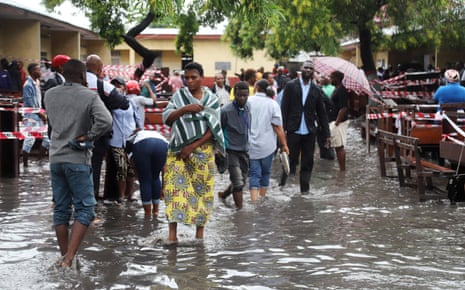
People walk through ankle-deep flood waters next to a polling station, with wooden benches piled up to one side and cordoned off
theguardian.org

Democracy is under mounting threat from the climate crisis, with new analysis documenting how elections are increasingly shaped not only by political forces but also by floods, wildfires and extreme weather.

At least 94 elections and referendums across 52 countries have been disrupted by climate-related impacts over the last two decades, researchers found.

As risks intensify, the pressure on already fragile democratic systems – particularly in Africa and Asia – is forecast to grow.

The findings, from the International Institute for Democracy and Electoral Assistance, an intergovernmental organisation that aims to support democracy around the world, is the first global analysis of how natural hazards are affecting elections.

In 2024, those hazards disrupted 23 elections in 18 countries, including Brazil, Bosnia and Herzegovina, and Senegal, either by damaging infrastructure, displacing voters or precipitating last-minute changes to electoral processes.

The report’s co-author, Sarah Birch, a professor of politics at King’s College London, said elections should be timed to avoid predictable climate threats, noting that even the US was still intent on staging elections in November, during its hurricane season.

“Elections should be held when disasters are least likely,” she said. “In some cases, electoral management bodies will also need to consider alterations to election timelines to reduce the likelihood of disruption by short-lived disasters.”

The findings highlight more than 100 climate-related crises, including Mozambique’s 2019 election, when Cyclone Idai submerged thousands of houses, schools, power lines and roads and people were forced to move to safer locations, events that the report states “affected the results of the presidential election and the distribution of legislative and provincial seats”.

Another example is the flooding that took place during Senegal’s parliamentary election in November 2024, when firefighters were required to help bring election observers to polling stations.

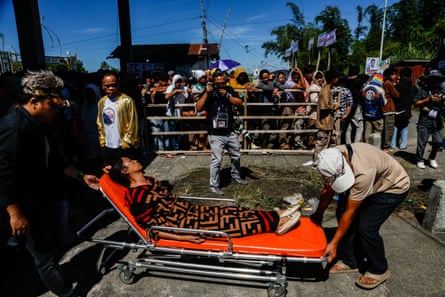
Heatwaves are another recurring problem, with at least 10 elections since 2022 affected by very hot weather. Among them was the general election in the Philippines last year, when intense heat meant that some vote-counting machines overheated on election day and ejected previously accepted ballots.

Heat is a particular threat to elections in the world’s megacities, which have populations of more than 10 million. The Nigerian city of Lagos now has the most days a year – 89 – where local temperatures are significantly above pre-climate change levels.

To help mitigate the impact of extreme climate events, the report advocates for those organising elections to work closely with meteorological experts, environmental protection bodies, and disaster relief and humanitarian agencies.

Election staff in Peru, for instance, have received training in disaster risk management to help them respond to disruptions on voting day. Next year, the Alberta provincial legislature in Canada will move its traditional election date in May to October to avoid the wildfire season.

Ferran Martínez i Coma, a professor of government at Australia’s Griffith University, said: “As natural hazards increase, training and contingency planning is more important than ever. Preparation is key to the integrity and resilience of the elections.”

An unconscious Filipina is carried away on a stretcher as people queue in hot sun behind them

Continue ReadingHeatwaves, floods and wildfires pose rising threat to democracy, report finds

Trump officials consider sending 1,100 Afghans who aided US forces to Congo

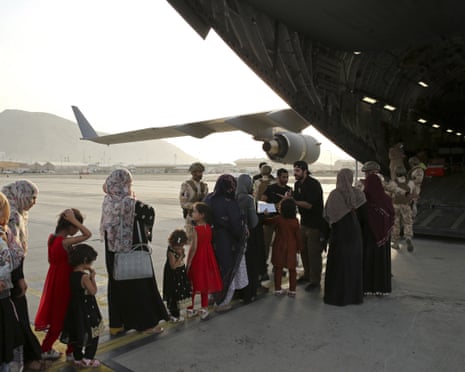
people stand in line in front of a plane

The Trump administration is in discussions to potentially send up to 1,100 Afghans who helped US forces during the war in Afghanistan to the Democratic Republic of Congo (DRC), a non-profit confirmed on Tuesday.

The resettlement talks, first reported by the New York Times, come after Donald Trump’s decision to stop an initiative that allowed Afghans who assisted US war efforts to apply to resettle in the US.

This group of more than 1,000 Afghans, who have been waylaid in Qatar for a year, reportedly includes interpreters as well as relatives of US military members. The group also includes more than 400 children.

According to the Times, the US evacuated these Afghans to Qatar for their protection because they supported US military efforts in their home country, which, since the US military withdrawal, is once again under Taliban control.

The DRC, meanwhile, is suffering from an enormous displacement crisis following decades of conflict and instability. According to the UN Refugee Agency, 8.2 million people were displaced as of September 2025, with this number expected to reach 9 million by year’s end.

Shawn VanDiver, president of the non-profit AfghanEvac, told the Guardian that he had heard about these discussions from people at, and around, the US state department.

VanDiver said that 900 of the 1,100 Afghans in Qatar were eligible for resettlement in the US. For the 200 that are not eligible, the US could talk to countries other than the DRC – which is reeling from violence – about accepting them.

“The others should just come here,” VanDiver said. “This is an easy solve: ‘Hey, welcome to America.’” VanDiver said between 100 to 150 of these Afghans are family members of active duty service members, while more than 700 are women and children.

“It’s insane – this could all be fixed just by a policy change,” VanDiver said, saying that the Department of Homeland Security could allow in Afghans who have already qualified for the program. “They can come here – there’s no law that is preventing them.”

It’s also possible that the DRC talks will not materialize into actual resettlement, leaving this group of Afghans in still more limbo. Given their cooperation with US forces, returning to Afghanistan would likely result in death, VanDiver said.

Asked for comment, a state department spokesperson said they are continuing to identify options for voluntary resettlement of the Afghans currently living at Camp As-Sayliyah (CAS) in Qatar and claimed moving this group to “to a third country is a positive resolution” for their safety and that of Americans. The spokesperson added “the Afghan nationals at CAS do not currently have a viable pathway to the United States”.

The state department says it’s in routine, direct communication with camp residents on resettlement initiatives but because of the sensitivity, they won’t reveal details surrounding the negotiations.

Continue ReadingTrump officials consider sending 1,100 Afghans who aided US forces to Congo

Taiwan president blames China for forced cancellation of Eswatini trip

President Lai Ching-te with two mics and red curtain behind

Taiwan’s president, Lai Ching-te, has cancelled his trip to Eswatini, the democratic island’s only diplomatic ally in Africa, after his government said several countries had revoked overflight permits because of “intense pressure” from China.

Lai was to leave on Wednesday for the 40th anniversary of King Mswati III’s accession.

The secretary general of Taiwan’s presidential office, Pan Meng-an, said Seychelles, Mauritius and Madagascar unilaterally and without warning revoked flight permits for the presidential aircraft to cross their countries.

“The actual reason was intense pressure exerted by Chinese authorities, including economic coercion,” he told a hastily called news conference in Taipei.

China’s foreign ministry did not immediately respond to a request for comment.

China, which has deep economic and political ties with Africa, says Taiwan is one of its provinces and has no right to call itself a country.

Speaking to Mozambique’s president, Daniel Chapo, in Beijing on Tuesday, the Chinese president, Xi Jinping, pledged support for the continent and its development needs, according to state media. It did not mention Lai’s cancelled visit to Eswatini.

Lai, in a post on social media, said China’s “suppressive actions” demonstrated the threat authoritarian states posed to international order, peace and stability. “No threat or suppression can change Taiwan’s determination to engage with the world, nor can it negate Taiwan’s ability to contribute to the international community,” he added.

Seychelles’ foreign affairs ministry told Reuters the Taiwanese president’s plane had not been granted clearance for overflight or landing, in line with the government’s longstanding policy of not recognising Taiwan’s sovereignty.

“The decision was taken independently and in accordance with established procedures,” Aline Morel, a senior protocol officer at the ministry, said.

A Madagascar foreign ministry official also confirmed having denied an overflight request. “Malagasy diplomacy recognises only one China. The decision was made in full respect of Madagascar’s sovereignty over its airspace,” the official said.

Mauritius did not immediately respond to requests for a response.

It would be the first time a Taiwanese president has had to cancel an overseas trip owing to Chinese pressure. Taiwanese presidents normally have no problems overflying countries with which the island does not have formal relations, but China harbours a particular dislike of Lai, whom it calls a “separatist”.

Lai says only Taiwan’s people can decide their future, and rejects Beijing’s sovereignty claims.

A senior Taiwan security official told Reuters the government understood that China had threatened to impose economic sanctions against Seychelles, Madagascar and Mauritius, including revoking debt relief.

This would have been Lai’s first trip outside Taiwan since November 2024, when he visited the Marshall Islands, Tuvalu and Palau, and transited through Hawaii and the US territory of Guam.


Continue ReadingTaiwan president blames China for forced cancellation of Eswatini trip

China urges U.S. to abandon excessive use of national security concept

BEIJING, June 5 (Xinhua) — China has urged the United States to abandon its generalized and excessive use of the national security concept, and to collaborate with all parties in maintaining a rules-based multilateral trading system, the Ministry of Commerce said on Thursday.

At a regular press conference, He Yongqian, spokesperson for the ministry, made the remarks when asked to comment on the U.S. decision to raise tariffs on imported steel, aluminium and their derivative products from 25 percent to 50 percent.

He said that such U.S. moves not only harm others and itself, but also will severely disrupt the stability of global industrial and supply chains.

The United States should abandon the zero-sum mentality, address respective concerns through equal dialogue, and jointly maintain the stability of global industrial and supply chains, He said.

Source: Xinhua

Continue ReadingChina urges U.S. to abandon excessive use of national security concept

Beijing registers first high-temperature day of 2025

A resident uses an umbrella to block the sun during the first high-temperature day of the year in Beijing, June 5, 2025. The Beijing Meteorological Observatory issued an orange heat alert at 6 p.m. on June 4. (China News Service/Chen Fangting)

A resident uses an umbrella to block the sun during the first high-temperature day of the year in Beijing, June 5, 2025. The Beijing Meteorological Observatory issued an orange heat alert at 6 p.m. on June 4. (China News Service/Chen Fangting)

People take sun protection measures during the first high-temperature day of the year in Beijing, June 5, 2025. The Beijing Meteorological Observatory issued an orange heat alert at 6 p.m. on June 4. (China News Service/Chen Fangting)

People take sun protection measures during the first high-temperature day of the year in Beijing, June 5, 2025. The Beijing Meteorological Observatory issued an orange heat alert at 6 p.m. on June 4. (China News Service/Chen Fangting)

A citizen shops for watermelons to cool off during the first high-temperature day of the year in Beijing, June 5, 2025. The Beijing Meteorological Observatory issued an orange heat alert at 6 p.m. on June 4. (China News Service/Chen Fangting)

Source: Ecns.cn

Continue ReadingBeijing registers first high-temperature day of 2025