Trump Administration Lowers Expectations for Trade Deals as Tariff Deadline Approaches

President Trump Participates In Invest America Roundtable At The White House

Less than 10 days till President Donald Trump’s higher “reciprocal” tariffs kick back in for most of the world, the U.S. looks like it may emerge with just a handful of trade deals.

The President shocked the world and roiled markets on April 2, which he dubbed “Liberation Day,” when he imposed tariffs of as high as 50% on nearly every country, before announcing a 90-day reduction in a stunning reversal just a week later. That pause, however, is ending July 9, and Trump said in a Sunday interview on Fox News, taped Friday, that he doesn’t intend to extend the deadline—although, he added, “I could, no big deal.”

[time-brightcove not-tgx=”true”]

On Friday, Trump said he could do “whatever we want” with the deadline. “I’d like to make it shorter. I’d like to just send letters out to everybody, ‘Congratulations, you’re paying 25%,’” he told reporters. 

Trump’s unpredictable style has earned him the descriptor “TACO” for “Trump Always Chickens Out,” while businesses, economists, and investors have criticized him for creating a volatile business environment. The President and his officials have countered that the uncertainty is all part of a master strategy to achieve better deals.

But the level of trade success Trump will have achieved by next week looks to fall short of his goals. Trump’s trade adviser Peter Navarro touted “90 deals in 90 days” in April. As the deadline approaches though, others in the Administration are lowering expectations.

“We’re going to do top 10 deals, put them in the right category, and then these other countries will fit behind,” Commerce Secretary Howard Lutnick said on Bloomberg Television last week.

Treasury Secretary Scott Bessent echoed Lutnick on Fox Business on Friday: “If we can ink 10 or 12 of the important 18—there are another important 20 relationships—then I think we could have trade wrapped up by Labor Day [Sept. 1].” For other “smaller trading partners, we will just send them letters,” Bessent said on CNBC.

Trade talks run into issues

Japan was one of the first countries to begin trade negotiations with the U.S. after the pause was announced, but talks have been troubled by disagreements over Japan’s policies protecting domestic rice.

“To show people how spoiled Countries have become with respect to the United States of America, and I have great respect for Japan, they won’t take our RICE, and yet they have a massive rice shortage,” Trump posted on Truth Social on Monday. (Japan imports 770,000 metric tons of rice every year without any tariffs, around half of which comes from the U.S.) “In other words, we’ll just be sending them a letter, and we love having them as a Trading Partner for many years to come.”

The “letters” that Trump likes to reference will notify countries of what rate their goods will be tariffed at, which Trump said on Fox News would mark “the end of the trade deal.”

With some trading partners, Trump’s strong-arm style has won him immediate concessions. Trump railed against Canada on Friday, announcing that he was ending trade talks over its proposed digital services tax, which he called “a direct and blatant attack on our Country.” On Sunday, Ottawa said it was abandoning the tax policy to resume negotiations with Washington in the hopes that it can reach a deal with the U.S. by July 21. White House Press Secretary Karoline Leavitt said Canada “caved.”

Similarly, the European Union on Monday reportedly yielded to a 10% levy on many of its exports, as it pushes for lower rates on specific key sectors and exemptions to higher tariffs on automobiles as well as steel and aluminum.

But Trump’s hardball tactics could also sour important U.S. trade relationships, and in the long term push countries to seek alternative trading partners. The E.U., alongside its negotiations with the U.S., is preparing countermeasures to tariff U.S. goods and has stepped up discussions with China around their trade relationship in recent months.

Jayant Menon, a research fellow at ISEAS-Yusof Ishak Institute, previously told TIME that countries will look to diversify their trade and engage with “more reliable” trading partners. And many have already begun, said Kristina Fong, an economic affairs researcher at ISEAS-Yusof Ishak Institute, especially in terms of increasing trade with China. “It’s a very slow burn kind of momentum, but that’s always been, I think, the underlying case,” Fong told TIME.

Moreover, “smaller trading partners” that haven’t even gotten a seat at the negotiating table are likely to be hit hardest. Trump’s apparent dismissal of these countries, similar to his decision to shutter USAID, suggests that he doesn’t see the benefits of having positive relations with them.

Many of them were already hit with some of the highest “reciprocal” tariffs when they were initially announced, and many aren’t in a position to simply purchase more American goods. Lesotho, which was hit with the highest 50% rate, was pessimistic at the outset of the pause, with the country’s trade and industry minister saying, “I don’t have a good experience with trying to get meetings with [the Trump Administration].”

“We’ll look at how a country treats us—are they good, are they not so good? Some countries we don’t care, we’ll just send a high number out,” Trump said on Fox News. “Congratulations, we’re allowing you to shop in the United States of America. You’re going to pay a 25% tariff or 35% or 50% or 10%.”

“What does this do long term to trust and confidence [in the U.S.]?” says Mark Cogan, associate professor of peace and conflict studies at Japan’s Kansai Gaidai University, tells TIME. “You’re bullying your way to get what you want, and that reduces trust. To a certain extent, parties will assume eventually that they cannot negotiate with the United States because perhaps the United States is not negotiating in good faith.”

China says its interests must be safeguarded

Countries seeking quick and favorable deals with the U.S. also face a balancing act with China. 

China has attempted to position itself as a reliable and stable partner, in contrast with Trump’s erratic style, and to strengthen its relations with other countries. Trump’s tariffs “were accelerating a trend of Chinese businesses looking more and more overseas,” William Figueroa, an assistant professor of international relations at the University of Groningen, previously told TIME.

China, which signed an agreement with the U.S. in May that temporarily lowered both nations’ levies on each other after an escalating tariff war, has warned that countries should not reach deals with the U.S. at the expense of China’s interests.

China is on a separate timeline for negotiating with the U.S., with its 90-day pause beginning May 14, though the two countries have already reached a limited deal.

“China firmly opposes any party reaching a deal for so-called tariff reductions at the expense of China’s interests. If that happens, China would never accept it and would take resolute countermeasures to safeguard its legitimate rights and interests,” China’s Ministry of Commerce said in a statement on Saturday.

“China is happy to see all parties resolve trade disputes with the US through equal consultations,” the statement added. “At the same time, we call on them to stand on the side of fairness and justice and firmly defend international and multilateral trade rules.”

Xu Weijun, a researcher with the Institute of Public Policy at the South China University of Technology in Guangzhou, told SCMP that Beijing, which has repeatedly called Trump’s tariffs “unilateral bullying,” is watching Trump’s trade talks with caution.

“Trump is an emotionally driven leader with a history of flip-flopping. Beijing knows too well it must prepare for him reneging on commitments or using deals with other countries to extract concessions [from China],” Xu told SCMP.

But, Xu cautioned: “If Trump believes the U.S. is losing in a deal or thinks attacking China and stoking nationalist sentiment serves his domestic political agenda, he could easily overturn existing consensus and even scrap signed agreements.”

Deals may still fall short of expectations

Trump has boasted about his deals with the U.K. and China, but critics say these agreements are not substantive or fail to address some of Trump’s key concerns.

Trade experts suggest that other deals may end up similarly appearing more like broad frameworks with many details left to be worked out later.

Tim Meyer, a professor at Duke University law school who specializes in international trade, told Bloomberg: “I would expect the White House will announce some number of frameworks that it’s going to call trade deals, but do not meet anyone’s ordinary understanding of that term.”

Continue ReadingTrump Administration Lowers Expectations for Trade Deals as Tariff Deadline Approaches

How I Learned to Love My Body—Especially in the Summer

Copy of *HEADER TEMPLATE - 1

There is a day we New Yorkers quietly celebrate, that we don’t have a name for.

It’s the morning when I can feel the earth peel back her blanket and stretch out for the first time in months. For once, she doesn’t have to reach for a sweater to throw over her nightgown; she might even step outside to greet the day.

I do the same, stepping outside to bask in the symphony of new sounds: the silly flap of sandals against the pavement, the no‑nonsense buzz of a bee hard at work, the crunch of a bunny snacking on wildflowers. No, that’s me getting carried away; there are no bunnies in my industrial part of Brooklyn.

But it is the first kiss of summer.

If you live in bear country and not Brooklyn, the warm months are signaled not with sundress debuts and iced coffee orders, but with the grumbles and growls of furry beasts who have emerged from hibernation.

Hibernation isn’t sleep. It’s a mastery of evolution, a collection of advanced adaptations and seemingly miraculous physiological strategies that allow so many critters to burrow underground for months without food or water and still look like their fuzzy, glorious selves as they totter out of their dens. After a hearty shake, the animals are rested and ready for action, with healthy, shiny fur coats at that.

But, however wondrous and exotic the ritual seems, hibernation is a challenging concept when you really get to thinking about it: What if humans were just as in tune with our bodies? Would it work out for us? What if we followed our bodily cues as attentively as bears and other animals do?

It took me a long time to learn I am a body. In a society that splits the mind as separate from the body, I question my own desires and needs as they arise. I even distrust them, commanding them to keep quiet so I can function normally in this culture that has so many ways to hide bodily requirements.

[time-brightcove not-tgx=”true”]

In most of contemporary society, we are practically forced to disembody if we want to have any chance at fitting in, keeping a job, getting accepted, even being seen as fully human. It is so outrageous (yet somehow normal) that grocery stores sell “hunger-reducing” gum and Ozempic is easily accessible so that our bodies can’t tell us when to eat, and absurd that we follow a labor schedule that was created for machines, and so upsetting that things like periods and panic attacks are seen as pesky hindrances to be hidden and worked through rather than honored with rest and support.

Read More: How To Use Your Body To Make Yourself Happier

Something I love about animals is that you never have to tell an animal “Be yourself.” They know no other way to be. Animals go to the bathroom, reject unwanted affection, gobble food, sleep for hours, and bite their toenails without a moment of hesitation or a shameful glance around to see if anyone’s looking.

The messages between their fuzzy bodies and their brains don’t go through any filtering system. Thought and action are practically one and the same: Hungry! Eat; Tired! Rest; Curious! Explore.

Animals have mastered embodiment, the experience of being a body rather than having a body. They don’t separate their physical self as an unruly object to control, argue with, be proud of, or disdain.

And for a long time, we humans were the same way. That is, until Plato came along and decided that body and mind were two different entities. His coping mechanism to escape the grind of Ancient Greece was to call the mind the “true self,” whereas a body was just a sloppy vessel to carry it around. While bodies were used and hurt by others, and, let’s face it, were kind of embarrassing, the mind was pure and could attain enlightenment.

It’s an interesting idea, but it’s gotten us into all kinds of trouble throughout history. Disembodiment, which denies any inherent preciousness of the body, has been used in service to humanity’s most egregious sins, from slavery to eugenics. If you can separate a body from a person, you’re more likely to accept the use of that body as an object. It now means that we endure the legacy of disembodiment as an accepted concept.

Take swimsuit season. As far as we’ve come from the SlimFast lunches and cabbage soup diet of the early 2000s, a lot of us still have diet culture leftovers lingering around in our minds when it comes to public displays of body appearance—especially their annual debuts in the summer.

I used to feel nothing but dread when I’d realize while packing my beach bag that I’d forgotten to get those abs I meant to get over the winter, or that last night’s dinner party with friends was showing up in some extra tummy bloat. I treated my rolls and squishy parts like they were evidence of my failures—a visible symbol that I lacked the saintly discipline that I’ve envied in other girls since middle school.

But bodies are living things who are entitled to change, strengthen, soften, expand, and spill out as evidence of a life lived—not a life restricted. A dinner party with friends is one of my greatest pleasures, and I didn’t get around to those abs in winter because I was too busy enjoying time for needed and delicious rest. If I’m a little flabbier for naturally responding to my joys and environment, so be it. Plunging into a swimming pool is another one of my greatest pleasures, and we all deserve to feel the unselfconscious glory of being a body in water on a hot day.

I quit blaming myself for my body’s naturalness when I learned to love life—not just my life, but the existence of any life on earth. The more I appreciated living things and their living-thing-ness, the more merciful I was toward myself. Subsequently, I learned to love signs of life: eye wrinkles, rolls of fat, chubby cheeks, jiggly arms, laugh lines, stretch marks, cellulite dimples, and colorful veins…all signs of vitality, age, changes, growth, and aliveness.

I smile when I think about bears who never have to learn any of this. They eat when they’re hungry, wander when they’re restless, and sleep when they’re tired. Somehow, after months in a comfy cave, they witness summer as the rest of us do: with energy and renewal. And it’s because they never questioned what their bodies needed.

When I catch myself questioning my needs, or scrutinizing my physical appearance, I remember what my soul experiences as a body: smelling the clothes of people I love, hearing cumbia music, applying blush, swimming in a cold lake, trying to stifle a laugh when it’s not appropriate to laugh, carrying an ice cream cone, twirling.

The first time I realized all that was the first time I really felt at home here, in my body. I know what it’s like to hate this home, and I know what it’s like to love being in it. I know what it’s like to feel my body as a brutalist office building made of concrete walls and right angles, restrictions and doors where I didn’t know the entrance code. And I know what it’s like to be in my body as a cozy cabin on a lake.

When I splash around a pool, more attentive to my soul’s elation than to the shape of my being in a bathing suit, I feel in touch with my human animal self, who experiences all the joys on earth through this natural, ever-changing body.

From HOW TO BE A LIVING THING by Mari Andrew, published by Penguin Life, an imprint of Penguin Publishing Group, a division of Penguin Random House, LLC. Copyright © 2025 by Mari Andrew.

Continue ReadingHow I Learned to Love My Body—Especially in the Summer

Charlize Theron joins chorus of disapproval over Timothée Chalamet’s ballet comments

Charlize Theron at Palm Royale FYC event in Los Angeles

Actor and former ballet dancer Charlize Theron has joined the chorus of disapproval aimed at Timothée Chalamet over his remarks that appeared to disrespect performers of ballet and opera.

In an interview with the New York Times, Theron said: “Oh, boy, I hope I run into him one day,” adding: “That was a very reckless comment on two art forms that we need to lift up constantly because, yes, they do have a hard time. But in 10 years, AI is going to be able to do Timothée’s job, but it will not be able to replace a person on a stage dancing live.”

Theron, who studied as a teenager at the Joffrey Ballet in New York before a knee injury prevented her from continuing with the art form, also commented on the physical price dancers pay. “It taught me to be tough. It’s borderline abusive. There were several times that I had blood infections from blisters that just never healed. And you don’t get a day off. I’m literally talking about bleeding through your shoes.”

Chalamet made the comments in February during a video conversation with fellow actor Matthew McConaughey, in which he said: “I don’t want to be working in ballet or opera … Things where it’s like, ‘Hey, keep this thing alive, even though no one cares about this any more.’” High-profile figures including Jamie Lee Curtis, Sam Taylor-Johnson, ballet star Misty Copeland, Eva Mendes and Helen Hunt have previously registered their disapproval of Chalamet’s remarks, while Italian film-maker and opera director Luca Guadagnino, who cast Chalamet in the 2017 film Call Me By Your Name, defended the actor, saying he didn’t “understand how one [single] comment can become a planetary polemic”.

In the interview, Theron also discussed her childhood and teenage years in South Africa, including her father’s death after being shot by her mother in self-defence. Theron described her father as a “full-blown functioning drunk” and said that her mother “sent me to a boarding school specifically because she wanted me to get out of the house”.

She described in detail the day of the shooting, when her father came to their house in June 1991 in Benoni, near Johannesburg, and attempted to break in. Theron said: “He shot through the steel doors to get in, making it very clear that he was going to kill us … [My mother] came into my bedroom. The two of us were holding the door with our bodies because there wasn’t a lock on it. And he just stepped back and started shooting through the door. And this is the crazy thing: not one bullet hit us.”

Theron added: “He walked to the [gun] safe, and my mom pulled the door open … [and] she followed my father, who was by then opening the safe to get more weapons out, and she shot him.”

Theron’s mother Gerda was not prosecuted for the shooting, after South Africa’s attorney general ruled it was an act of self-defence. Theron said: “The next morning she sent me to school. She was just like, We’re going to move on. Not necessarily the healthiest thing, but it worked for us.”

Continue ReadingCharlize Theron joins chorus of disapproval over Timothée Chalamet’s ballet comments

Iranian American woman arrested in Los Angeles for alleged arms trafficking

people stand at airport by sign saying 'welcome to los angeles'

A California woman was arrested at Los Angeles international airport after allegedly trafficking weapons on behalf of the Iranian government to contacts in Africa, including Sudan.

Shamim Mafi, 44, of Woodland Hills was detained on Saturday night by federal agents, according to the top federal prosecutor in Los Angeles.

Mafi was charged on the suspicion of “brokering the sale of drones, bombs, bomb fuses, and millions of rounds of ammunition manufactured”, wrote Bill Essayli, first assistant US attorney for the central district of California, in a post on X.

Mafi, an Iranian national, has been a lawful permanent resident of the US since 2016. Mafi maintains a US residence but frequently travels to Iran, Turkey and Oman, according to a criminal complaint obtained by Fox News.

The complaint against Mafi states that she lived in Istanbul, Turkey, from 2013 to 2016. In one interview with federal officials, Mafi said that her first husband was an officer for Iran’s ministry of intelligence and security, the intelligence arm of the Iranian government.

Mafi and a co-conspirator, who was not named in court documents, allegedly brokered weapons deals through their company Atlas International, according to records obtained during an authorized search. The illegal weapons dealing allegedly took place in several locations, including in California, according to the complaint.

In one such deal, Mafi allegedly facilitated the sale of Iranian-manufactured drones by the Iranian government to Sudan’s ministry of defense, a contract valued at more than €60m. Mafi herself reportedly earned $6m euros in payment after “[coordinating] the Sudanese delegation’s travel to Iran”.

Sudan has been fighting a civil war since 2023, a conflict that has killed as many as hundreds of thousands of civilians and displaced upwards of 13 million people in the region.

Pictures posted to social media include Mafi posing with weapons at a warehouse in Turkey and enjoying a beach day in California, the Los Angeles Times reported.

If convicted, Mafi faces up to 20 years in federal prison. She is expected to make her first court appearance on Monday at the US district court in Los Angeles.

Continue ReadingIranian American woman arrested in Los Angeles for alleged arms trafficking

Arrests fuel fears among Madagascar’s gen Z protesters that new regime no better than one they overthrew

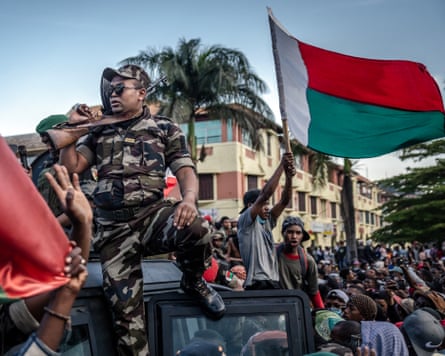
Three young people on top of vandalised vehicle with plume of black smoke amid crowd

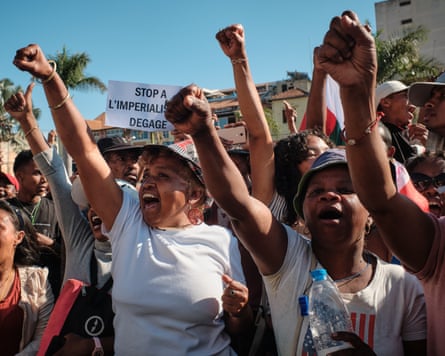
The arrest of several protesters in Madagascar has increased fears among young people that the military regime that took power last year after huge Gen Z demonstrations will be no better than the government it overthrew.

Four Gen Z activists, Herizo Andriamanantena, Miora Rakotomalala, Dina Randrianarisoa and Nomena Ratsihorimanana, were arrested on 12 April, one of their lawyers said, two days after taking part in a protest calling for an election date to be set.

They are accused of offences related to undermining state security and criminal conspiracy, said Aliarivelo Maromanana. “They’ve all denied it and there’s no evidence whatsoever,” he said.

Col Michael Randrianirina came to power in a coup in October 2025 after weeks of youth-led protests under the banner Gen Z Madagascar.

His spokesperson, Harry Laurent Rahajason, asked about the arrests, said: “Here in Madagascar there is what we call the separation of powers. So the presidency has nothing to do with cases dealt with by the national police.”

Two of the activists were released and admitted to hospital on Tuesday, Maromanana said. On Friday, only Herizo, the group’s leader, was still in detention. Local media quoted the national police as saying that the activists were not harmed or intimidated during detention and the two in hospital had taken ill.

Two more activists were arrested on Wednesday night, Gen Z 261, one of the groups that emerged from the previously leaderless Gen Z Madagascar movement, said on Thursday. No further information was available about their detention.

Young people had been jubilant when the previous president, Andry Rajoelina, fled in October. However, many have since become disenchanted by Randrianirina’s choice of government officials, whom they see as being part of the old, corrupt elite; a lack of economic reforms; and the new regime’s closeness to Russia.

The arrests raise “serious concerns around the respect for fundamental freedoms,” said Ketakandriana Rafitoson, a Transparency International Madagascar board member. “It is a pattern we saw under the previous administration and one that many hoped would be broken with the transition. So [last] Friday’s protests were a test for this regime and they failed it.”

Madagascar, an Indian Ocean island of 32 million people, is rich in biodiversity and natural resources, including vanilla, rubies and sapphires.

However, the former French colony has been bedevilled by coups and corruption, as well as cyclones and droughts that have been made worse by the climate crisis. In 2024, it was the fifth poorest country in the world, with a GDP per capita of $545 (£403), according to the World Bank.

September’s protests erupted after two councillors in the capital, Antananarivo, were arrested for protesting against water and electricity outages. Since the regime change, these services have not substantively improved, said Elliot Randriamandrato, a leader of Gen Z Madagasikara, another Gen Z Madagascar group.

He said: “For the moment, there’s no real reforms that have been implemented by the government. That’s maybe why everyone is so frustrated, because we don’t see anything clear and visible.”

Randriamandrato said he was less concerned with the government announcing an election date – the president has said it would be within two years of his October takeover – than with a new constitution.

“We ask for more clarity on the date of the constitutional consultation, because the date and the methodology and the way they’re going to lead this important moment … it’s during those consultations that the real issues are going to be addressed,” he said.

He cited electoral reform as one example of the change his group wanted, adding: “It’s [currently] a system that only permits people with more money to win.”

The president’s spokesperson, asked about the constitutional reform process, referred to a press conference he had held on Wednesday where he told reporters authorities were investigating corruption estimated at 3,811bn ariary (£679m) and linked the investigations to threats to the president.

Rahajason showed a video of what he said were drones flying above the president’s home on the night of 11 April, Radio France Internationale reported. He also said there was a plan to set the national parliament on fire.

Meanwhile, the military regime has received donations of military trucks, helicopters and tanks from Russia, after Randrianirina visited Putin in Moscow in February.

Shely Andriamihaja, a member of Gen Z Madagasikara, said her group was “very worried about the risk of new state capture from foreign countries”, adding that she was not defending Madagascar’s former colonial ruler, France.

Rahajason confirmed there were Russians in Randrianirina’s presidential guard. Asked for the number and the reason for their presence, he replied: “Why are you asking this question? … Why did the Ukrainian president call on guards of other nationalities? Why is it normal? And why, when a Malagasy calls on the services of international guards, why is it not normal?”

Madagascar flag waved by protesters and army personnel on top of vehicle
Happy people waving fists

Continue ReadingArrests fuel fears among Madagascar’s gen Z protesters that new regime no better than one they overthrew

Weather tracker: hail covers parts of Tunisia and Algeria like snow

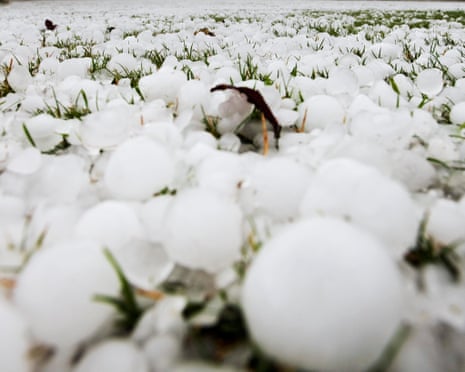
A garden is covered with hailstones in Les Esserts after a hail storm hit the western part of Switzerland

Severe thunderstorms have affected the Mediterranean this week. On Monday, a surface low-pressure system in the Mediterranean in conjunction with an upper air cut-off low, led to thunderstorms over north Africa. Their intensity was aided by the hot precursor conditions.

Algeria and Tunisia were notably affected by the thunderstorms, with some hail accumulation layers as a result. When so much hail forms, it starts to lay down sheets of hail, covering the ground like snow. Hail accumulations of up to 3cm were reported in Oum Ladjoul and Hammam Sokhna in Algeria, and there were hailstones of up to 3cm in diameter in Makthar, Tunisia. Thunderstorms continued in the region through the following day, with further hail accumulations, notably in Ouled Bousmir, Tunisia, where there was a layer about 2cm deep.

Later in the week, another surface low developed, this time over Sicily. Consequentially, thunderstorms broke out across parts of central Italy on Wednesday morning. These led to some severe downpours, with 52.1cm of rain falling in just over an 1 hour and 10 minutes in the city of Ascoli Piceno and 62.3mm falling in less than 1 hour and 50 minutes in the town of Mosciano Sant’Angelo. Other regions were also affected, with 46mm of rain in 36 minutes in the Sicilian town of Bagheria, as well as heavy rain being recorded in Algeria and Tunisia.

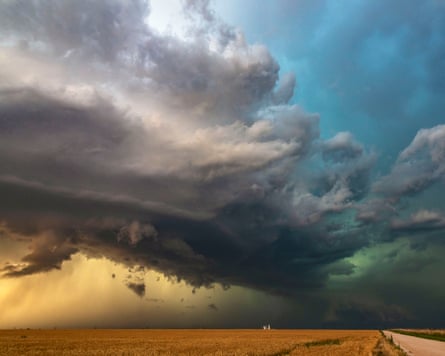
There were severe thunderstorms elsewhere in the world this week, notably parts of the north-east US. On Tuesday evening, a supercell affected Dane county, Wisconsin, and as a result, a tornado warning was in force. According to radar, a tornado did occur, but there were no confirmed reports of it touching the ground. However, this supercell also led to some severe hail. Around Madison, baseball-sized hailstones were reported. At 7cm in diameter, these would have been twice the size of those reported in Tunisia.

The following day, severe storms continued in the north-east US, these spreading into Ohio. During this outbreak, even bigger hail was reported, with softball-sized stones being seen near Kansas City – stones as large as 11.5cm in diameter.

Tornadoes were also a big player in these storm outbreak, with about 20 across the US this week, primarilyin Wisconsin, Kansas, Iowa and Minnesota.

A severe hail storm works its way across the high plains of Kansas in 2021.

Continue ReadingWeather tracker: hail covers parts of Tunisia and Algeria like snow