

Ubuntu users can now file bugs against specific Launchpad PPAs
 Launchpad now offers bug tracking for personal package archives (PPAs), making it easier for users to report issues specific to software within a PPA. Why does that matter? Well, not all PPAs are maintained by their upstream counterparts – folks who, frankly, aren’t always minded to care about quirks in their software that might be down to someone else’s packaging methods. Plus, PPAs are often used to provide newer or experimental versions of software that the version in the standard Ubuntu repositories, and different PPAs can distribute different versions of the same software. With the new tracking support, users can […]
You’re reading Ubuntu users can now file bugs against specific Launchpad PPAs, a blog post from OMG! Ubuntu. Do not reproduce elsewhere without permission.

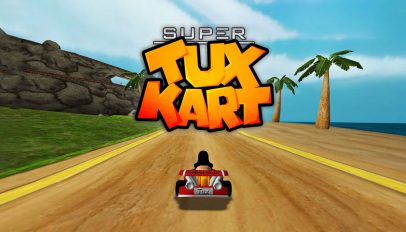 SuperTuxKart has taken several online services offline, having pulled the server that powers them rather than risk it being exploited by PHP2shell. The open-source karting game is not alone in ‘pitting’ to patch, with Wikimedia, DeviantArt, government websites and many more taking various systems offline to harden against it. While offline, gamers can’t reset their online account passwords, check rankings or upload new add-ons. Offline components, like split-screen and LAN multiplayer, do work, as do online add-on downloads and online play, but only for registered users. SuperTuxKart notes that attempts to exploit php2shell were recorded as early as 17 October, […]
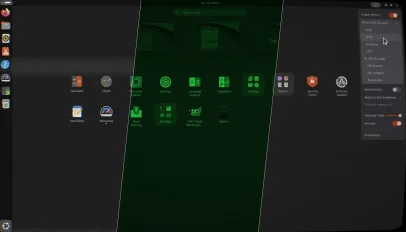 Ever wondered what your Ubuntu desktop would look like if you were watching it on a chewed up VHS tape or an old monochrome CRT monitor? You probably haven’t, but a new GNOME Shell extension lets you find out anyway. The Shader Effects extension applies GPU-accelerated filters, things like scan lines, NTSC RGB bloom and flickery green CRT glow, to your entire desktop or, if you’d rather, just a specific window(s). You can see three of the effects demoed in this video clip: The extension’s preference panel lets you fine-tune how intense the chosen effect is, and you can dial […]
 Calibre 9.17 has been released with faster ebook conversion speeds and JPEG XL image support. The open-source ebook editor improves output compression speeds for MOBI, AZW3 and PDB files, which makes conversions to those formats quicker. Converting EPUB to MOBI is what I use Calibre for to read on my ancient Kindle. Calibre 9.17 can read JPEG XL images in eBooks and other supported documents during conversions. The format offers high image quality at smaller file sizes and supports features like HDR. JPEG XL is not new, but its popularity (and browser support) is on the up. Accessibility improvements see […]

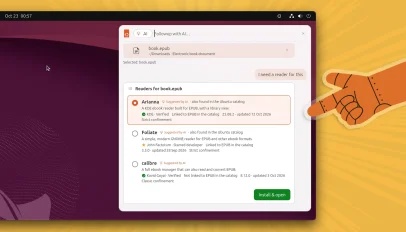 What would deeper AI integration on the Ubuntu desktop look like? Well, you don’t need to think too hard to find out. A Canonical engineer has published a prototype launcher that simulates how on-device AI could be used to enhance and aid users of the Ubuntu desktop. But the warty-prototype snap by Didier Roche-Tolomelli (aka didrocks) is not a real launcher. It’s a semi-interactive, automated mockup. It simulates things a user could do, and that includes interacting with a (theoretical) on-device AI model to complete tasks. The Snap Store listing refers to it as a ‘design-discussion prototype of the next Ubuntu […]