
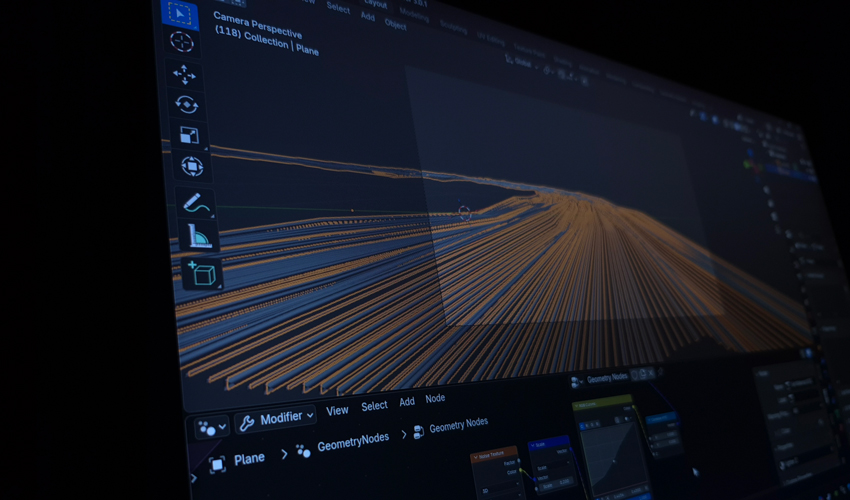
The Blender Foundation has officially released Blender 5.3, introducing a major change to the open-source 3D creation suite by enabling Vulkan as the default graphics backend on Linux and supported Windows systems. Released on November 10, 2026, the update represents an important milestone in Blender’s transition toward modern graphics APIs while delivering substantial improvements to rendering, modeling, animation, video editing, and procedural workflows.
The move to Vulkan is particularly significant for Linux users because Blender has traditionally relied on OpenGL for much of its viewport rendering. With Blender 5.3, Vulkan becomes the standard backend on Linux, while OpenGL remains available as an alternative for troubleshooting and compatibility. The release also lowers the minimum Vulkan requirement to version 1.1, allowing a broader range of graphics hardware and drivers to participate in the transition.
Beyond the graphics backend, Blender 5.3 introduces native 3D Gaussian Splatting support, NVIDIA DLSS 4.5 Ray Reconstruction denoising, improved material shading in Cycles and EEVEE, new Geometry Nodes capabilities, and a redesigned video-editing workflow. Together, these changes make the release one of Blender’s most substantial updates of 2026.
Vulkan Becomes Blender’s Default Graphics Backend on Linux
The most important technical change in Blender 5.3 is the transition to Vulkan as the default GPU backend on Linux and Windows, excluding Windows on ARM. This marks a significant step away from the OpenGL-based rendering infrastructure that has supported Blender’s interface and viewport operations for many years.
Vulkan is a modern, low-level graphics API designed to provide applications with more explicit control over GPU resources, command submission, synchronization, and memory management. Unlike OpenGL, which hides many implementation details behind a higher-level driver interface, Vulkan gives developers greater responsibility for managing graphics operations.
This design can reduce driver overhead and provide more predictable performance when applications are carefully optimized. It is particularly relevant to complex software such as Blender, where the viewport must continuously process geometry, materials, lighting, overlays, and user interactions.
The change affects Blender’s GPU backend used for viewport and interface rendering. It does not mean that every rendering engine or operation now uses Vulkan exclusively. Cycles continues to use its own supported compute and rendering technologies, including CUDA, OptiX, HIP, oneAPI, and CPU rendering where applicable.
By adopting Vulkan as the default, Blender establishes a modern foundation for future graphics development while retaining OpenGL as an alternative when required.